

























Initial policy considerations for generative artificial intelligence


Abstract
Generative artificial intelligence (AI) creates new content in response to prompts, offering transformative potential across multiple sectors such as education, entertainment, healthcare and scientific research. However, these technologies also pose critical societal and policy challenges that policy makers must confront: potential shifts in labour markets, copyright uncertainties, and risk associated with the perpetuation of societal biases and the potential for misuse in the creation of disinformation and manipulated content. Consequences could extend to the spreading of mis- and disinformation, perpetuation of discrimination, distortion of public discourse and markets, and the incitement of violence. Governments recognise the transformative impact of generative AI and are actively working to address these challenges. This paper aims to inform these policy considerations and support decision makers in addressing them.
Introduction
Generative artificial intelligence (AI) has already demonstrated its transformative potential in a wide range of policy areas. Its capacity to generate text, images, audio and video content extends its relevance to areas of healthcare, education, labor and employment and beyond. The innovative application for these technologies poses numerous challenges and risks to individuals, companies, economies, societies, and policymaking around the globe, ranging from near-term labour-market disruption and disinformation to potential long-term challenges in controlling machine actions.
The purpose of this report is to inspire deeper consideration into the significant policy implications associated with generative AI. In particular, it highlights some of the immediate and long-term considerations that carry social, political and economic repercussions.
This report recognises how generative AI could revolutionise industries and society but, equally, carries significant risks. As such, it discusses generative AI:
- Is being developed and adopted rapidly.
- Influences the quality and accessibility of information available to users.
- Introduces novel challenges relating to Intellectual Property Rights (IPR) and copyrights.
- Could impact labour markets on a large scale.
- Is being discussed with regards to its longer-term trajectories and associated potential risks and benefits.
GenAI systems influence the quality & accessibility of information
Generative AI systems have already become mainstream tools used by millions of individuals daily. However, current generative AI applications prove that they are not yet entirely reliable nor trustworthy informational tools.
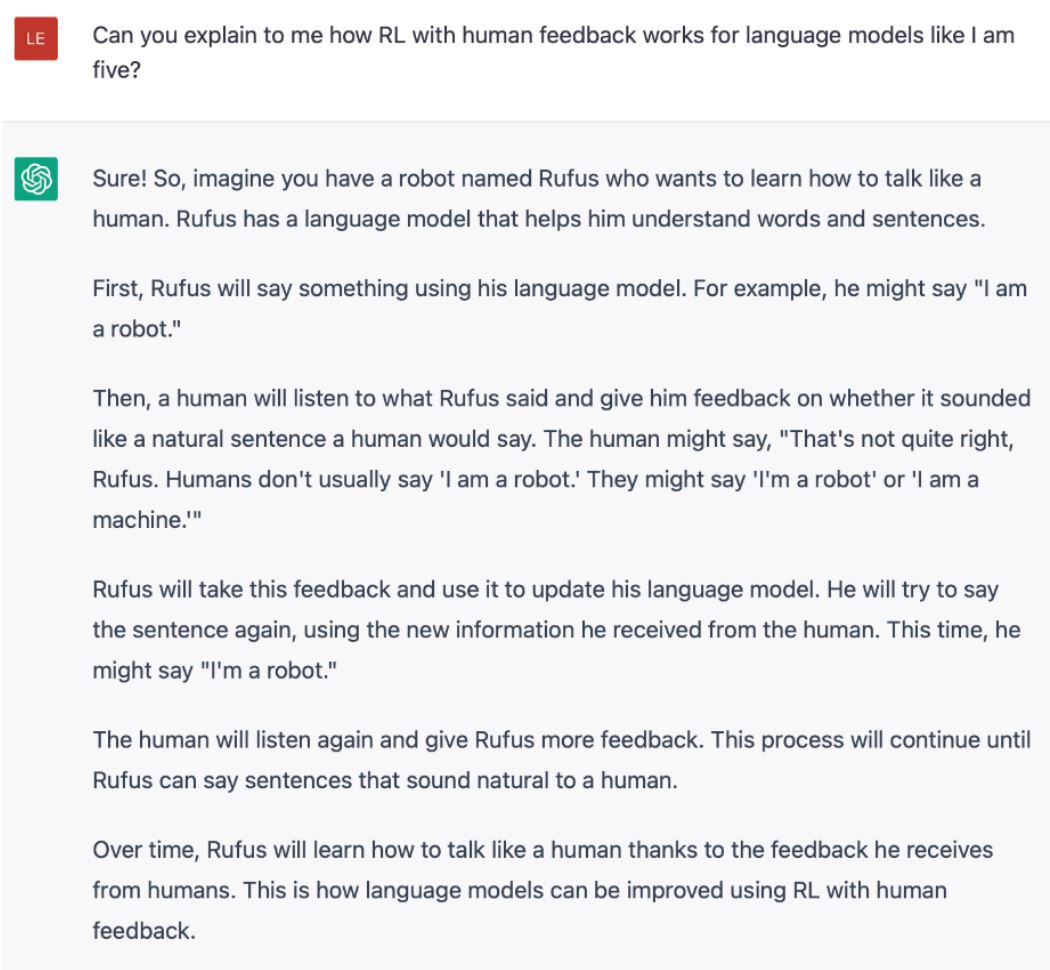
Embedded biases and Reinforcement Learning with Human Feedback (RLHF) mechanisms allow these systems to perpetuate discriminatory content. Without proper oversight, like use-limits or monitoring, bad actors can use these tools to produce harmful content, including targeted disinformation campaigns with severe social, political and economic repercussions.
ChatGPT explains RLHF as part of an overview by HuggingFace
Generative AI can echo, automate, and perpetuate social prejudices, stereotypes and discrimination by replicating biases contained in training data. This can exacerbate the marginalisation or exclusion of specific groups.
Novel solutions to address mis- and disinformation from generative AI are imperative. Policy initiatives seeking to monitor and verify the content generated by AI will be crucial in setting standards and good practices that protect the quality of information that circulate informational ecosystems and enhance the trustworthiness and security of generative AI systems.
Generative AI systems pose unknowns for IP
Generative AI models are trained on vast amounts of data from the Internet which often includes unauthorised copyrighted material.
The WIPO Secretariat published a paper in May 2020 on IP policy and AI that highlighted eight key issues, including questions such as whether the use of copyrighted data without authorisation constitutes an infringement of copyright and, if so, whether there should be an exception that allows for the training of machine learning models
These sophisticated technologies can produce new images, text, and audio that are novel, raising questions about whether generated outputs can be copyrighted or patented. Because legal systems around the world differ in their treatment of IP the treatment of AI-generated works varies between countries making it difficult to establish common practices and standards for ownership rights to the material generative AI systems are trained on.
The nature of generative AI also raises additional concerns, like whether artificially generated outputs can themselves be copyrighted or patented and if so, to whom? To date, most jurisdictions agree that works generated autonomously by AI are not copyrightable. However, if generative AI systems cannot be awarded copyrights, the work could be assigned to somebody else, such as the system programmer. Legal systems will eventually need to recognize AI-generated works and those involved in the creation of AI-generated content to properly address copyright and ownership rights moving forward.
GenAI could impact labour markets on a different scale and scope
The OECD Employment Outlook notes that AI can benefit jobs by creating demand for new tasks and complementary skills, resulting in new jobs for which human labour has a comparative advantage. The Initial Considerations report also highlights how AI has advanced in its capacity to perform non-routine cognitive tasks which can support work requiring information-ordering, memorisation, and perceptual speed, as well as literacy and literacy skills.
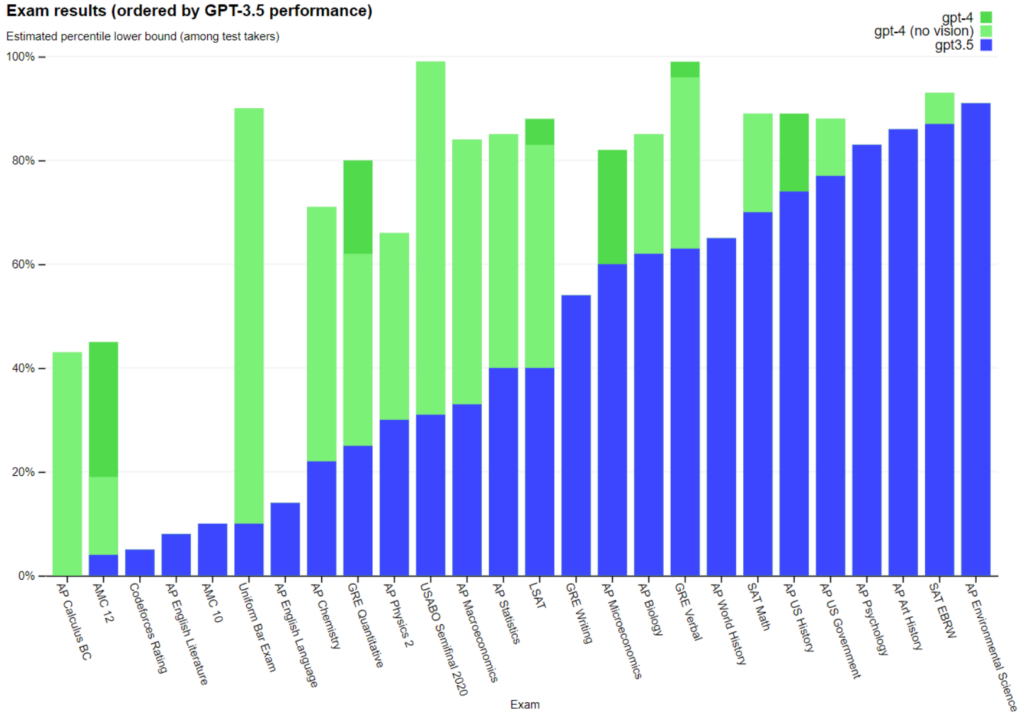
GPT performance on academic and professional exams
However, the occupations at the highest risk of automation from AI account for about 27% of employment and a significant share of workers worry about losing their jobs entirely to AI in the next ten years – particularly those who already work with AI. There remain many unknowns about the longer-term advancements and implications of generative AI for the labour market. Nevertheless, organisational change strategies are needed, including building awareness of what is needed to bridge emerging skills gaps, improve current skills, and develop new ones, while fostering openness towards AI technologies and working to prevent anxiety around misperceptions. Policy is needed to optimise labour market benefits while effectively addressing risks and unknowns to protect workers’ rights and well-being.
Potential futures of GenAI
Sophisticated AI technologies like generative AI are advancing at a highly accelerated rate and it is not expected to slow down anytime soon. Recent projections estimate that generative AI could account for a 7 percent rise in global domestic product in the next 10 years.
Comparisons of Midjourney images from v1 to v5

Developments in generative AI provide immediate considerations that, if left unaddressed, can mature into systemic harms and collective disempowerment. The nature of generative AI provides an environment whereby today’s data and users’ behaviours can inform the training and functions of future generative AI systems, and therefore, is expected to exacerbate existing issues associated with AI This could include existing concerns relating to the labour market, information quality, the negative ecological footprint of AI technologies and computing, and mass surveillance and censorship, for example.
Risks from emerging model behaviours are equally critical to address. Although it remains fiercely debated, recent AI safety research raises issues specifically around generative AI models exhibiting unforeseen “emergent behaviours”, such as increased agency and power-seeking tendencies. Increased agency of algorithmic systems presents unique challenges. However, most alarmingly, likely include systemic, delayed harms that can be destructive, long-lasting and difficult to address, and collective disempowerment, which can slowly erode human decision-making power.
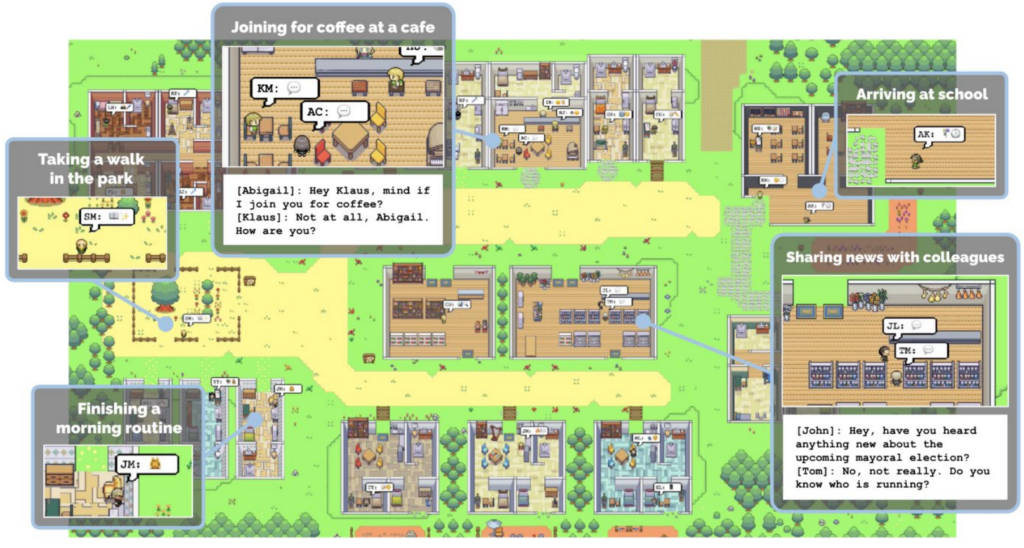
Sims-like environment for AI agents
The pace in which generative AI is evolving further highlights the urgency for policy action aimed at addressing the known challenges posed by generative AI before they become widespread, mainstream and systemic. The benefits and risks of AI deployment, coupled with its rapid pace of development and integration in society serve to validate the need for critical policy action designed to preserve the benefits AI offers while also addressing the risks of generative for users, as well as those most vulnerable to its integration, such as workers, content creators and marginalised populations.