


These tools and metrics are designed to help AI actors develop and use trustworthy AI systems and applications that respect human rights and are fair, transparent, explainable, robust, secure and safe.
AI Facts
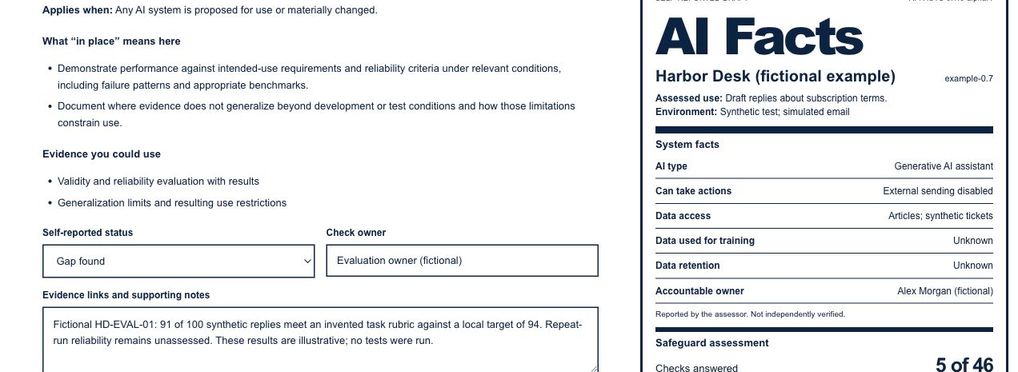
AI Facts is an independent Decision Terrain tool with a project-authored checklist mapped to NIST AI RMF 1.0. It is not affiliated with, sponsored by, or endorsed by NIST. It helps system owners, governance teams, evaluators, and reviewers create a shared record of an AI system and its intended use, including reported safeguards, supporting information, unresolved risks, and review responsibilities.
The tool provides 40 project-authored checks across the NIST AI Risk Management Framework 1.0 functions Govern, Map, Measure, and Manage. A published mapping traces these checks to the framework's 72 subcategories. Six optional checks address generative AI and agents, including generated content, tool permissions, and external actions; these do not constitute a complete mapping to NIST's Generative AI Profile.
Users record system facts, assessment scope, self-reported statuses, evidence notes, owners, next actions, and review details. They can generate SVG or HTML AI Facts labels, a full HTML AI Facts assessment report, and an importable JSON backup, or print to PDF. Unknowns, gaps, and exclusion reasons remain visible. Markdown and CSV materials support a document-based review workflow.
The browser editor requires no account. Assessment content is stored locally in the user's browser and is not uploaded by the editor. The source can also be run locally using a static web server. Software is MIT-licensed; original checklist content is licensed under CC BY 4.0. Brand artwork has separate terms.
AI Facts is a public alpha (release 0.1.0-alpha.1; checklist 0.1.0-draft). The checklist has not been tested through a real organizational assessment and is available for exploration and practitioner feedback. Entries are self-reported; the tool does not validate evidence, calculate a safety score, or determine deployment readiness. It does not establish certification, compliance, or safety.
About the tool
You can click on the links to see the associated tools
Tool type(s):
Objective(s):
Impacted stakeholders:
Purpose(s):
Target sector(s):
Country/Territory of origin:
Lifecycle stage(s):
Type of approach:
Maturity:
Usage rights:
Target groups:
Target users:
Stakeholder group:
Geographical scope:
People involved:
Required skills:
Risk management stage(s):
Technology platforms:
Use Cases
Would you like to submit a use case for this tool?
If you have used this tool, we would love to know more about your experience.
Add use case


 Partnership on AI

