These tools and metrics are designed to help AI actors develop and use trustworthy AI systems and applications that respect human rights and are fair, transparent, explainable, robust, secure and safe.
Enterprise-Wide AI Risk Management (EW-AiRM™)
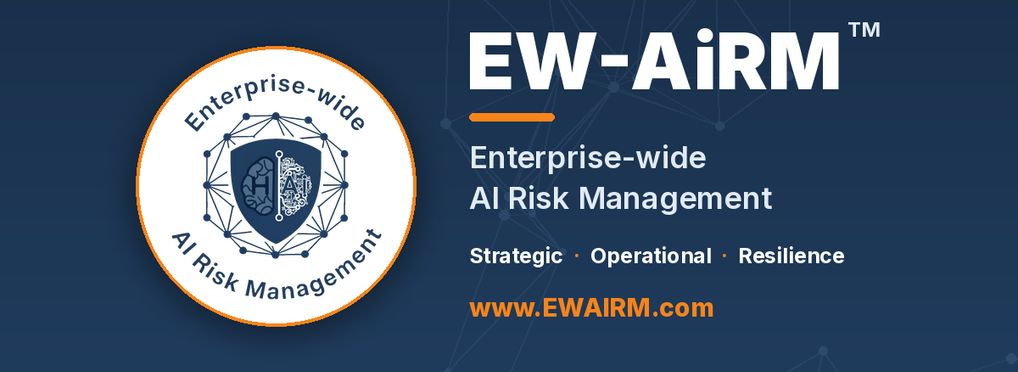
EW-AiRM™ (Enterprise-Wide AI Risk Management) is a comprehensive framework for governing artificial intelligence across an entire organisation. It is the direct successor to HAiPECR™, listed in this catalogue since April 2023 [1], and continues a lineage that began with the Global Conduct Risk Paradigm (GCRP) and the Universal Conduct Risk Paradigm (UCRP), published via the United Nations UNECE Working Party 6 in 2017 [2], and includes ECE/TRADE/486, the UNECE Common Regulatory Arrangement on products embedding AI (2024), applicable across the 56 UNECE member states [3].
Where HAiPECR™ provides the ethical and conduct-risk lens, EW-AiRM™ provides the full enterprise operating model around it. The framework is structured across three layers: Strategic (board-level governance, risk appetite and accountability), Operational (day-to-day risk identification, assessment, controls and monitoring across the AI lifecycle) and Resilience (eight AI Black Swans, incident response, recovery and preparedness for low-probability, high-impact events). Six supporting pillars span governance, risk, controls, culture, assurance and resilience, designed to integrate with existing enterprise risk management rather than sit alongside it.
HAiPECR™ is embedded as the framework's ethics, conduct and risk dimension. Its seven thematic dimensions are mapped to the ten core principles of UNESCO's 2021 Recommendation on the Ethics of Artificial Intelligence, with the privacy dimension additionally aligned to UNESCO's 2024 Recommendation on the Ethics of Neurotechnology, giving organisations a direct bridge from internationally agreed principles to auditable practice.
EW-AiRM™ is evidence-based and quantified. It incorporates the MIT AI Risk Repository, maintained by the MIT FutureTech team, covering more than 1,700 catalogued AI risks across 7 domains and 24 subdomains, with 831 mapped controls [4]. A master risk-to-controls mapping enables organisations to move from abstract principles to concrete, testable control environments. The framework also defines eight categories of AI Black Swan events (including multi-agent emergence and the quantum cryptographic transition) for tail-risk resilience planning, and five Non-Negotiables setting the minimum governance conditions for any deployment.
Implementation is proportionate through three tiers (Core, Standard and Full), allowing SMEs, corporates, financial institutions, public bodies and NGOs to adopt the same architecture at a depth appropriate to their exposure. Progress is monitored through KXIs (Key X Indicators), an umbrella for performance, risk and control indicators. The framework is published in full as a Wiley Finance book, Enterprise-Wide AI Risk Management [5], and supported by IRM and IOR practitioner training, an online course, an implementation toolkit and assessment tooling, all accessible via the framework website. It is designed to remain interoperable with the EU AI Act, ISO/IEC 42001, the NIST AI RMF and the Council of Europe Framework Convention on AI.
References
[1] HAiPECR, OECD.AI Catalogue of Tools & Metrics: https://oecd.ai/en/catalogue/tools/haipecr
[2] Universal Conduct Risk Paradigm (UCRP), UNECE WP.6 (2017): https://unece.org/fileadmin/DAM/trade/wp6/documents/2017/GRMF2F/2017_02_22_1400_Krebsz_UCRP_-_Draft_version_22_Feb_2017.pdf
[3] ECE/TRADE/486, UNECE Common Regulatory Arrangement on products embedding AI (2024): https://unece.org/trade/publications/ece_trade_486
[4] MIT AI Risk Repository, MIT FutureTech (CC BY 4.0): https://airisk.mit.edu
[5] Krebsz, M., Enterprise-Wide AI Risk Management, Wiley Finance (ISBN 9781394446476).
About the tool
You can click on the links to see the associated tools
Developing organisation(s):
Objective(s):
Impacted stakeholders:
Purpose(s):
Target sector(s):
Country/Territory of origin:
Lifecycle stage(s):
Type of approach:
Usage rights:
Target groups:
Target users:
Stakeholder group:
Validity:
Benefits:
Geographical scope:
People involved:
Risk management stage(s):
Technology platforms:
Tags:
- ai risks
- conduct risk paradigm
- ai risk management
- risk register
- ethical risk
- risk
- ai risk standard
- risk ontology
- ethical decision making
- ai risk mitigation
- ethical ai governance
- ew-airm
- enterprise-wide ai risk management
- markus krebsz
- haipecr ethics filter
- prof. markus krebsz
- enterprise ai
- risk assessment
- high risk ai systems
- ai risk register
- risk management
Use Cases
Would you like to submit a use case for this tool?
If you have used this tool, we would love to know more about your experience.
Add use case

 Partnership on AI