






















These tools and metrics are designed to help AI actors develop and use trustworthy AI systems and applications that respect human rights and are fair, transparent, explainable, robust, secure and safe.
Green Algorithms Calculator
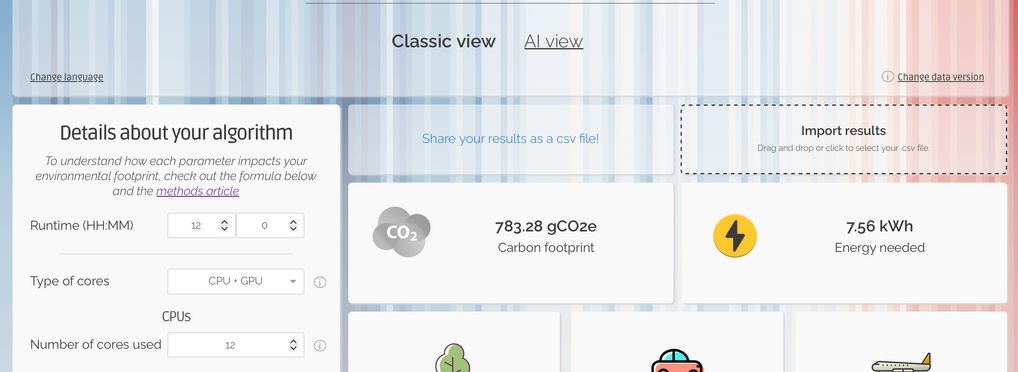
The calculator is aimed at developers of AI and computing models, as well as students and educators who want to learn more about the environmental impacts of their projects. It doesn’t require any installation, making it platform-agnostic and easy to adopt for new users.
It shows two panels to adapt to both traditional computing task and AI workflows, and allows users to enter characteristics of their task and their location to obtain estimates of carbon footprints and other environmental impacts.
Open source and documented in published work, it has been externally validated to ensure that the estimates are representative of the underlying energy usage of the system.
This tool is part of the Green Algorithms Initiative which develops tools and frameworks to empower practitioners to understand and mitigate the environmental impacts of their computing work. The Green Algorithms Initiative is run by the Cambridge Sustainable Computing Lab at the University of Cambridge.
AI Validation Analysis
Connection to Trustworthy AI Objectives: Environmental Sustainability: The calculator’s core function is to estimate and report the carbon footprint of algorithms, computations, and AI workloads, and to support reductions. This directly supports the objective’s focus on energy/resource efficiency and mitigation of environmental harm by making sustainability impacts measurable and comparable. Data Governance & Traceability: As an estimation/reporting tool, it can improve traceability of sustainability-related claims by documenting assumptions and inputs used to compute footprint estimates (e.g., hardware/usage parameters referenced by the tool). While it is not primarily a governance/audit system, its structured inputs and calculated outputs can support oversight and reproducibility of reported environmental metrics, which partially aligns with traceability.
Validation Score: 4/5
About the tool
You can click on the links to see the associated tools
Developing organisation(s):
Tool type(s):
Objective(s):
Impacted stakeholders:
Purpose(s):
Target sector(s):
Country/Territory of origin:
Lifecycle stage(s):
Type of approach:
Maturity:
Usage rights:
License:
Target groups:
Target users:
Stakeholder group:
Validity:
Enforcement:
Benefits:
Geographical scope:
People involved:
Required skills:
Risk management stage(s):
Technology platforms:
Tags:
- carbon reporting
Github stars:
- 125
Github forks:
- 33
Use Cases
Would you like to submit a use case for this tool?
If you have used this tool, we would love to know more about your experience.
Add use case



 Partnership on AI