


























These tools and metrics are designed to help AI actors develop and use trustworthy AI systems and applications that respect human rights and are fair, transparent, explainable, robust, secure and safe.
Pytorch implementations of neural networks
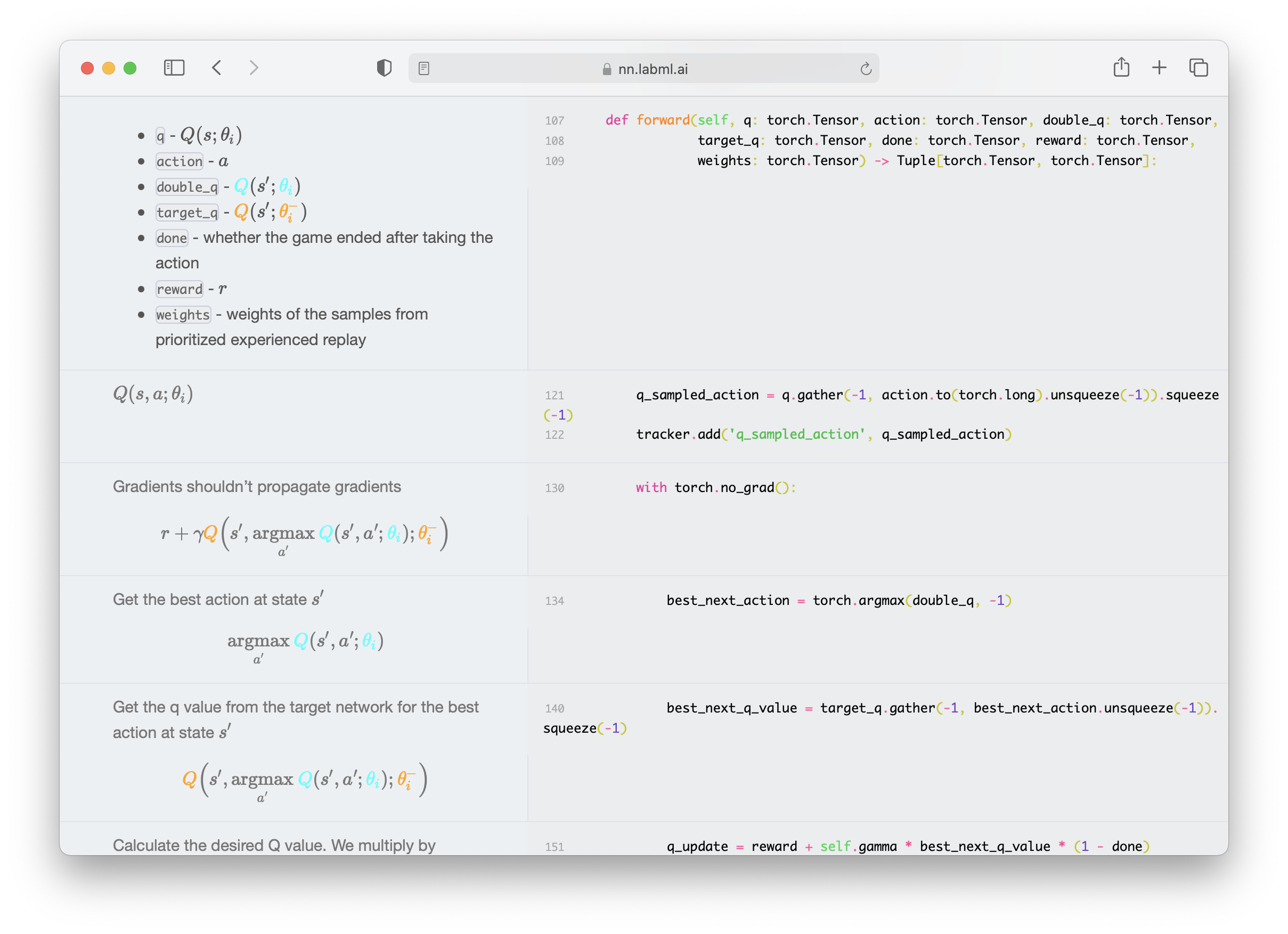
This is a collection of simple PyTorch implementations of neural networks and related algorithms. These implementations are documented with explanations,
The website renders these as side-by-side formatted notes. We believe these would help you understand these algorithms better.
We are actively maintaining this repo and adding new implementations almost weekly. 
Paper Implementations
 Transformers
- Multi-headed attention
- Transformer building blocks
- Transformer XL
- Rotary Positional Embeddings
- Attention with Linear Biases (ALiBi)
- RETRO
- Compressive Transformer
- GPT Architecture
- GLU Variants
- kNN-LM: Generalization through Memorization
- Feedback Transformer
- Switch Transformer
- Fast Weights Transformer
- FNet
- Attention Free Transformer
- Masked Language Model
- MLP-Mixer: An all-MLP Architecture for Vision
- Pay Attention to MLPs (gMLP)
- Vision Transformer (ViT)
- Primer EZ
- Hourglass
Eleuther GPT-NeoX
Diffusion models
- Denoising Diffusion Probabilistic Models (DDPM)
- Denoising Diffusion Implicit Models (DDIM)
- Latent Diffusion Models
- Stable Diffusion
Generative Adversarial Networks
- Original GAN
- GAN with deep convolutional network
- Cycle GAN
- Wasserstein GAN
- Wasserstein GAN with Gradient Penalty
- StyleGAN 2
Recurrent Highway Networks
LSTM
HyperNetworks – HyperLSTM
ResNet
ConvMixer
Capsule Networks
U-Net
Sketch RNN
Graph Neural Networks
Counterfactual Regret Minimization (CFR)
Solving games with incomplete information such as poker with CFR.
Reinforcement Learning
- Proximal Policy Optimization with Generalized Advantage Estimation
- Deep Q Networks with with Dueling Network, Prioritized Replay and Double Q Network.
Optimizers
Normalization Layers
- Batch Normalization
- Layer Normalization
- Instance Normalization
- Group Normalization
- Weight Standardization
- Batch-Channel Normalization
- DeepNorm
Distillation
Adaptive Computation
Uncertainty
Activations
Langauge Model Sampling Techniques
Scalable Training/Inference
Highlighted Research Paper PDFs
- FlashAttention: Fast and Memory-Efficient Exact Attention with IO-Awareness
- Autoregressive Search Engines: Generating Substrings as Document Identifiers
- Training Compute-Optimal Large Language Models
- ZeRO: Memory Optimizations Toward Training Trillion Parameter Models
- PaLM: Scaling Language Modeling with Pathways
- Hierarchical Text-Conditional Image Generation with CLIP Latents
- STaR: Self-Taught Reasoner Bootstrapping Reasoning With Reasoning
- Improving language models by retrieving from trillions of tokens
- NeRF: Representing Scenes as Neural Radiance Fields for View Synthesis
- Attention Is All You Need
- Denoising Diffusion Probabilistic Models
- Primer: Searching for Efficient Transformers for Language Modeling
- On First-Order Meta-Learning Algorithms
- Learning Transferable Visual Models From Natural Language Supervision
- The Sensory Neuron as a Transformer: Permutation-Invariant Neural Networks for Reinforcement Learning
- Meta-Gradient Reinforcement Learning
- ETA Prediction with Graph Neural Networks in Google Maps
- PonderNet: Learning to Ponder
- Mastering Atari, Go, Chess and Shogi by Planning with a Learned Model
- GANs N’ Roses: Stable, Controllable, Diverse Image to Image Translation (works for videos too!)
- An Image is Worth 16X16 Word: Transformers for Image Recognition at Scale
- Deep Residual Learning for Image Recognition
- Distilling the Knowledge in a Neural Network
Installation
pip install labml-nn
Citing
If you use this for academic research, please cite it using the following BibTeX entry.
@misc{labml,
 author = {Varuna Jayasiri, Nipun Wijerathne},
 title = {labml.ai Annotated Paper Implementations},
 year = {2020},
 url = {https://nn.labml.ai/},
}
Other Projects
 Trending Research Papers
This shows the most popular research papers on social media. It also aggregates links to useful resources like paper explanations videos and discussions.
 labml.ai/labml
This is a library that let’s you monitor deep learning model training and hardware usage from your mobile phone. It also comes with a bunch of other tools to help write deep learning code efficiently.
About the tool
You can click on the links to see the associated tools
Developing organisation(s):
Tool type(s):
Objective(s):
Purpose(s):
Type of approach:
Usage rights:
License:
Programming languages:
Github stars:
- 67752
Github forks:
- 6788
Use Cases
Would you like to submit a use case for this tool?
If you have used this tool, we would love to know more about your experience.
Add use case



 Partnership on AI


