





















These tools and metrics are designed to help AI actors develop and use trustworthy AI systems and applications that respect human rights and are fair, transparent, explainable, robust, secure and safe.
The AIM Framework (Awareness, Identification, Mitigation)
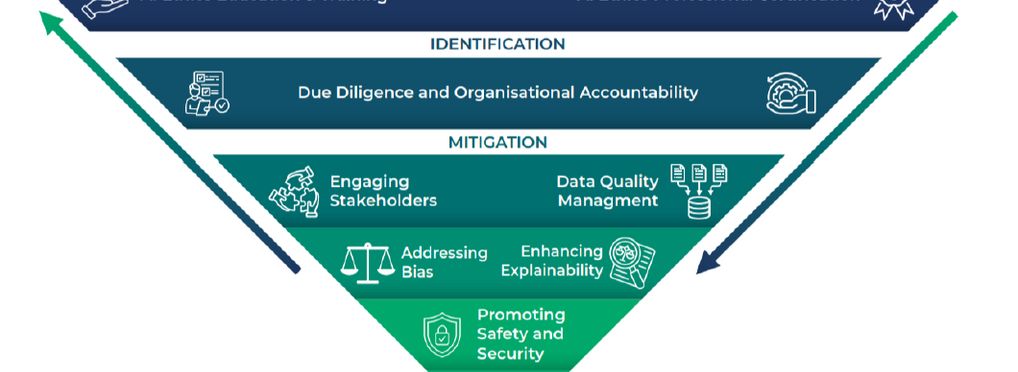
The AIM framework – Awareness, Identification, and Mitigation – presents a stepwise approach for the implementation of risk management strategies that enable the development of safe, secure, and trustworthy AI systems. Awareness of AI ethics encompasses the prerequisite AI ethics skills and knowledge which AI developers should acquire, so that they are familiar with the types of potential risks to fundamental rights which can arise and take proactive steps to prevent negative impacts. Identification encompasses the steps and measures for implementing a risk-based approach to mitigate harms to fundamental rights. The focus here is on the institutional policies, processes, and procedures for the characterisation and evaluation of possible risks to fundamental rights which can arise in the AI system development. Mitigation encompasses steps and approaches for ensuring that AI systems and models do not pose unacceptable risk to fundamental rights. These should be proportionate to the identified risks and appropriate to the purpose and functionalities of the AI system under development.
The AIM framework is a multi-layered tool which features a checklist with core areas of action which correspond to the three thematic components: awareness, identification, or mitigation. The checklist comprises 8 elements:
Awareness
- AI Ethics Education & Training
- AI Ethics Professional Certification
Identification
- Due Diligence and Organisational Accountability
Mitigation
- Engaging Stakeholders
- Data Quality Management
- Addressing Bias
- Enhancing Explainability
- Promoting Safety and Security.
Each checklist element is presented in terms of open-ended guiding questions which recognise that ‘one size does not fit all’ and indicate types of measures that are required for the effective implementation of each checklist element. The elements of the checklist are described in detail using indicative scenarios. The scenarios highlight key aspects related to the prevention of negative impacts on fundamental rights and showcase existing good practices which can be leveraged in this regard. The AIM framework is intended for AI developers and their institutions in academic, private, and public sectors. It provides a blueprint for approaching fundamental rights due diligence as an investment which ensures regulatory compliance, promotes innovation, and supports responsible conduct. The AIM Framework is available in English, Bulgarian, Dutch, Greek, and Estonian.
This tool was co-funded by the European Union. Views and opinions expressed are however those of the author(s) only and do not necessarily reflect those of the European Union or EACEA. Neither the European Union nor the granting authority can be held responsible for them.
About the tool
You can click on the links to see the associated tools
Developing organisation(s):
Tool type(s):
Objective(s):
Purpose(s):
Lifecycle stage(s):
Type of approach:
Maturity:
Usage rights:
License:
Target groups:
Target users:
Stakeholder group:
Technology platforms:
Github stars:
- 7
Use Cases
Would you like to submit a use case for this tool?
If you have used this tool, we would love to know more about your experience.
Add use case

 Partnership on AI