Name in original language
Sistemi i Mbivendosjes & Përqasjes Ligjore
Initiative overview
The initiative addresses the complex challenge of legislative inflation and regulatory fragmentation in Albania. As laws are frequently updated or introduced, manual cross-referencing against the entire Official Gazette becomes prone to human error, leading to jurisdictional gaps or redundant requirements that stifle economic growth and public trust.
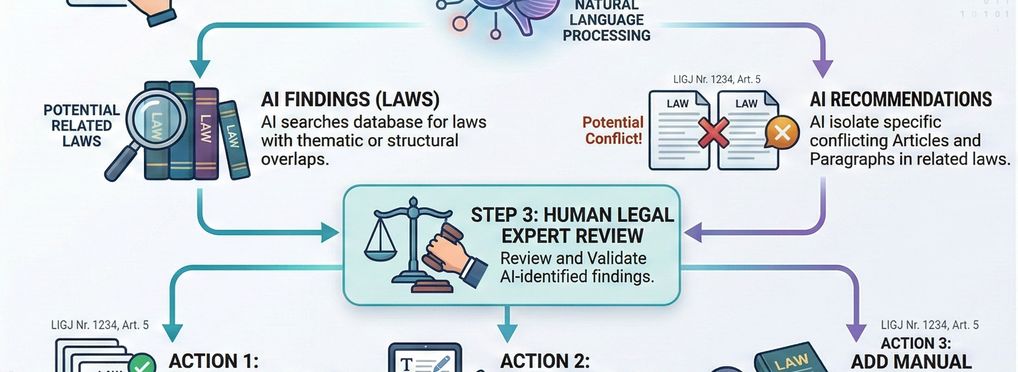
The primary objective is to leverage Large Language Models (LLMs) to scan, map, and analyse the interconnections between thousands of legal acts automatically via integration with the Official Gazette. The tool identifies where a new draft law might contradict an existing one or where multiple institutions claim authority over the same regulatory space.
Currently, the tool is fully integrated into the legislative workflow, allowing for real-time analysis of proposed legal changes. Future evolution focuses on the use of AI to automatically verify whether each draft complies with the Code of Administrative Procedures and the Constitution.
The system will also check every sub-law draft against its respective base law to ensure it does not exceed its delegated competences and that it fully addresses all obligations and requirements established in the parent legislation. Through these mechanisms, every draft will be subjected to a comprehensive and structured compliance checklist before approval.
Results, outcomes and impacts
The initiative has significantly reduced the time required for legal compliance checks, especially given that there are over 27,000 laws in the system. By using LLM-based semantic search, we have identified and flagged over 200 instances of critical legal overlaps that were previously undetected.
These results are measured through comparative analysis between manual reviews and AI-generated reports. Looking forward, we expect to achieve a reduction in regulatory contradictions in new legislation, leading to a more stable and predictable legal environment. Tangible impacts include faster processing of draft laws and a measurable decrease in legal disputes arising from conflicting administrative instructions.
Challenges and lessons learned
A major challenge was the complexity of the Albanian language in legal contexts, given that it is a low-resource language. We also faced initial resistance regarding the “black box” nature of AI. We responded by implementing a “Human-in-the-Loop” system where AI findings are presented as recommendations for legal experts rather than final decisions.
A key lesson is that data quality in the National Registry is paramount: AI is only as good as the archives it scans. Success requires a multidisciplinary team of AI specialists and senior jurists to bridge the gap between technical output and legal nuance.