


























The OECD.AI Policy Navigator

Our policy navigator is a living repository from more than 80 jurisdictions and organisations. Use the filters to browse initiatives and find what you are looking for.

Path for Cohesion


Added by:   OECD analyst
Added on:   16 Nov 2026
Updated by:   OECD analyst
Updated on:   16 Nov 2026

undefined
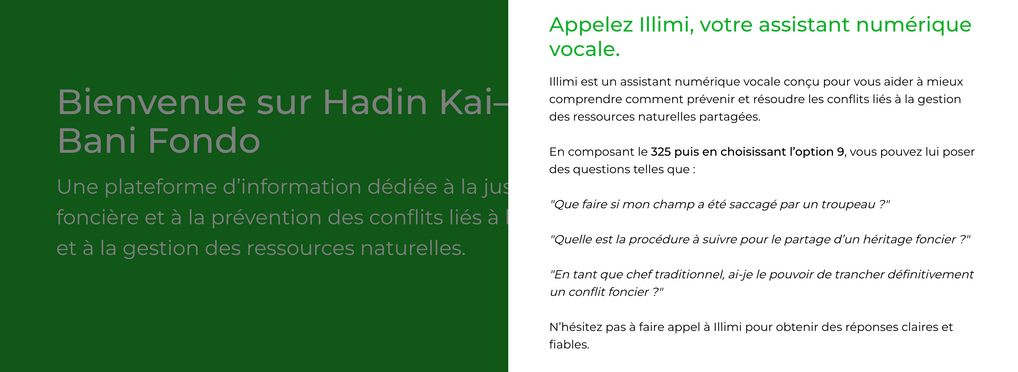
A free, voice-first AI phone service in Niger complements a digital platform by making nationally validated information accessible on any phone, including basic handsets. Callers ask about land and shared natural-resource disputes and receive step-by-step audio guidance grounded in a curated corpus using RAG. It supports traditional leaders with updated, reliable information while preserving their legitimacy.

Name in original language

Hadin kai–bani fondo

Initiative overview

“Hadin kai–bani fondo” (“the Path for Cohesion”) is a people-centred justice initiative in Niger addressing a major access-to-justice gap: land and shared natural resource disputes are frequent and serious, and are often managed first through customary authorities. Yet frontline actors (e.g., village and canton chiefs) and justice seekers may lack easy access to reliable, nationally aligned guidance, especially in low-connectivity and low-literacy contexts. The initiative leverages widespread access to basic mobile phones to deliver trusted guidance in voice format.

The objective is to improve access to consistent, practical information that supports early prevention and resolution of disputes. The solution includes a “vocal companion”: a toll-free interactive voice service accessible from basic phones. Users call a free short code, ask questions verbally, and receive spoken, step-by-step guidance. Answers are grounded in a curated, nationally validated corpus using a constrained retrieval-augmented generation (RAG) approach, with pre-approved non-generative responses for sensitive topics to reduce misinformation, avoid conflicts with norms, and maintain alignment with nationally accepted guidance. The service complements customary and administrative pathways, supporting traditional leaders with updated information while preserving their legitimacy.

The initiative was co-created through Niger’s 2023–2024 Justice Innovation Lab with government institutions, traditional leaders, civil society, farmers’ organisations, local authorities, and justice seekers. Governance is institutionally anchored: the Ministry of Justice leads, supported by a multi-actor committee (including ANAJJ, the Rural Code, the Association of Traditional Chiefs, and sectoral ministries). It is currently being piloted in Dosso and Tillabéri. The Ministry has launched it as a solution with potential for national scale-up and broader access for justice seekers.

Future evolution is expected to include expanding language coverage beyond French, improving the voice user experience, and potentially extending content to other common dispute types, while maintaining strong national governance, validation, and review of the corpus.

Other relevant details

Results, outcomes and impacts: Pilot logs show feasibility and real usage in rural, low-connectivity settings. From launch (15 December 2025) to 15 February 2026, the voice companion recorded 357 unique callers who accessed the service. Of these, 160 (45%) asked at least one question, and 139 (39%) received at least one valid response and listened to at least 75% of it. Impacts were measured through IVR/call logs (funnel metrics) and short in-call feedback surveys: 53.7% (66/123) said the information helped address their land issue; 66.7% (32/48) found it easy to understand; and 79.1% (34/43) would recommend it. Next, we expect higher uptake and broader impact as awareness grows and access expands. Challenges and lessons learned: Implementing Hadin kai–bani fondo revealed risks beyond the AI itself. We assumed one ministry partner plus outreach to traditional leaders would suffice; in practice, rollout required co-ordination across three ministries, slowing mobilisation. We strengthened institutional anchoring through a steering committee, co-ordination meetings, and an extended MoU. On the AI side, risks were hallucinations and norm conflicts in a legally plural context. These were mitigated with a tightly constrained RAG design, limited to a closed, curated, nationally validated corpus; sensitive topics were routed to pre-approved responses, with regular human review. Operationally, IVR drop-off and French-only access reduced uptake. Data protection requires careful handling of call logs and interaction data, with rules on access, retention, and anonymisation. Reliance on private voice/IVR providers (e.g., Viamo) makes robust contracts, clear responsibilities, and governance essential for continuity and trust.

About the policy initiative


Category:

  • AI policy initiatives, programmes and projects

Initiative type:

  • AI use cases/projects in the public sector

Status:

  • Active

Start Year:

  • 2025

OECD AI Principles:

—

Images: