

























📅 March 2026 update: The Hiroshima AI Process (HAIP) Reporting Framework is being streamlined and improved. A v2.0 will be available shortly. Participate in the pilot: OECD.AI/Transparency.
Date and time: 17 February 2026, 11:30 AM to 12:25 PM (IST)
Venue: West Wing Room 4B, Bharat Mandapam Convention Centre, New Delhi, India
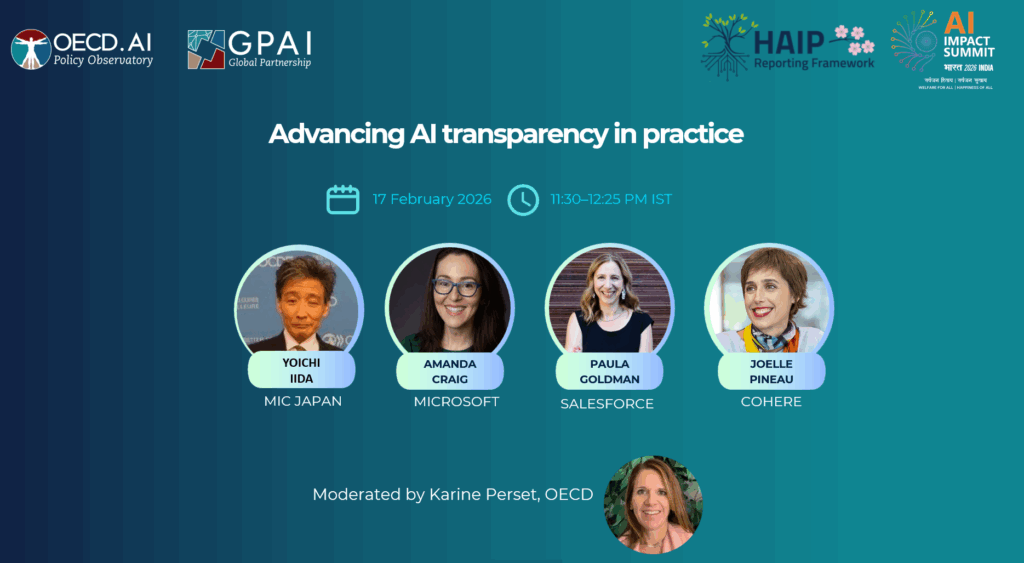
Co-hosted by the OECD, Japan’s Ministry of Internal Affairs and Communications, Infosys, and Microsoft, this discussion explored how to align national and regional policy frameworks with shared expectations for transparency, safety, and accountability.
Anchored in the Hiroshima AI reporting framework for advanced AI systems, the discussion explored how common reporting practices, risk disclosures, and transparency mechanisms can support both national policy objectives and cross-border trust. Participants discussed how voluntary frameworks, such as international reporting templates, assurance mechanisms, public–private collaboration on testing and evaluation, can complement national policies by enabling faster learning cycles, supporting innovation, and fostering convergence where it matters most for safety and rights.

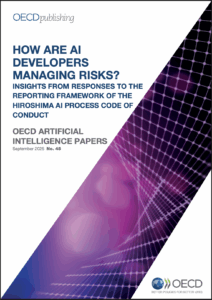
How are AI developers managing risks? Insights from responses to the reporting framework of the Hiroshima AI Process Code of Conduct
Rapid advances in artificial intelligence (AI) are reshaping economies and societies, creating significant opportunities while also raising important considerations around the effective governance and risk management of advanced AI systems. Launched in February 2025, the Hiroshima AI Process Reporting Framework is the first international, voluntary tool to help organisations report on their practices compared to the Hiroshima AI Process International Code of Conduct for Organisations Developing Advanced AI Systems. This report presents preliminary insights from submissions by 20 organisations across diverse sectors and countries, examining their approaches to risk identification and management, transparency, governance, content authentication, AI safety research, and the advancement of global interests.
- VISIT THE HAIP TRANSPARENCY FRAMEWORK AND ORGANISATION REPORTS
- Access the individual organisation reports
- Preliminary report from 2024 pilot: Towards a Hiroshima Artificial Intelligence Process Code of Conduct Reporting Framework: Findings from the Pilot (December 2024)