Inside AI risk management: early insights from the HAIP 2.0 reporting framework




This blog post is the first in a series analysing submissions under the HAIP Reporting Framework 2.0, which supports the application of the Hiroshima Process International Code of Conduct for Organisations Developing Advanced AI Systems launched during Japan’s G7 Presidency. Upcoming posts will look more closely at specific findings, starting with how organisations govern agentic AI.
The latest submissions to the Hiroshima AI Process (HAIP) Reporting Framework 2.0 offer insights into how the organisations developing and deploying the most advanced AI systems across the AI value chain identify, manage and communicate risks. Drawing on 31 reports submitted between June and September 2026, this blog explores who is reporting, and what reporting organisations are doing to manage AI risks and advance trustworthy AI.
As international attention to AI safety increasingly focuses on risk management, evaluation, incident reporting, and transparency these reports provide evidence of how organisations are translating AI governance commitments into practice.
The HAIP Reporting Framework 2.0
The HAIP Reporting Framework was developed by the OECD in response to a request from the G7, as a voluntary mechanism for organisations to report on their implementation of the Hiroshima AI Process International Code of Conduct for Organizations Developing Advanced AI Systems and more generally their practices for trustworthy AI. Following its official launch at the French AI Action Summit in February 2025, 25 reports were published in 2025 and analysed in the OECD report “How are AI developers managing risks?”. The Reporting Framework was updated in 2026 to simplify reporting, broaden participation across the AI value chain and reflect developments such as the growing use of AI agents. HAIP 2.0 was launched on the margins of the G7 Digital Ministerial and a Tech7 event in late May 2026.
By making these reports public, the framework aims to build trust, support peer learning across the AI ecosystem and promote international consistency. Organisations can submit a report on a rolling basis. Reports submitted by 15 January 2027 will inform a forthcoming OECD analytical report.
The framework is structured around seven themes that collectively cover the 11 actions in the Hiroshima Process International Code of Conduct:
- risk identification and evaluation;
- risk management and information security;
- transparency reporting;
- organisational governance and incident management;
- content authentication and provenance;
- research and investment; and
- advancing human and global interests.
Compared to the earlier version, HAIP 2.0 makes it easier to compare reported practices. Several questions now combine tick-box answers with free-text descriptions, allowing readers to see both how many organisations report a practice and how they put it into operation. It was also designed to broaden participation, particularly from SMEs, through a simpler and more structured reporting experience, and it connects organisations to the OECD.AI Catalogue of Tools and Metrics for Trustworthy AI, helping organisations identifying practical tools supporting their existing risk management processes, and contributing additional tools and resources, helping expand the Catalogue and strengthen the exchange of good practices across the ecosystem.
The revised framework also broadens the questions asked. Organisations now indicate their size and role in the AI value chain, providing context for interpreting their responses. New questions address aspects such as agentic AI, incentives for disclosing vulnerabilities, protection of sensitive AI assets, and the cost of compliance.
The responses already illustrate the relevance of these additions: 26 of the 31 organisations report developing or deploying AI agents.
A broader and more diverse group of reporting organisations
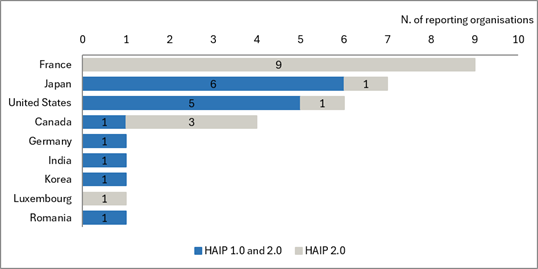
Nearly half of the organisations are participating for the first time and participation is more geographically diverse. The 31 reporting organisations that reported under HAIP 2.0 are based in nine countries across Asia, Europe and North America. France accounts for the largest number of reports, followed by Japan, the United States and Canada. Germany, India, Korea, Luxembourg and Romania each account for one report (Figure 1).
Figure 1. Reporting organisations by country
Reporting organisations also differ in size (Figure 2) and role (Figure 3). Twenty-one are large enterprises, while ten are small and medium-sized enterprises (SMEs), including five micro-enterprises.
Their activities fall into three broad groups:
- Fifteen are large AI developers and technology firms, including developers of frontier AI models.
- Eleven apply AI in specific sectors. Health and life sciences is the most common, with five organisations ranging from digital health platforms to clinical research and medical devices. The others work in education, mobility, legal services, digital labour platforms, digital advertising and customer relations.
- Five provide AI consulting, governance, compliance or software development services to other organisations.
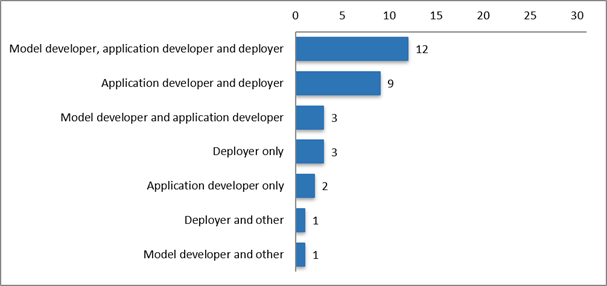
These groups do not map neatly onto a single role in the AI value chain. The largest group, 12 of the 31 reporting organisations (39%), operates across the full chain, from model development to application development and deployment. The next largest group, nine organisations (29%), develops applications and also deploys them. The remaining ten are more specialised (Figure 2).
Figure 2. Size and role across the AI value chain of reporting organisations
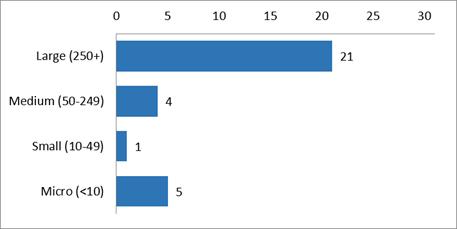
Figure 3. Role across the AI value chain of reporting organisations
Identifying risks
All 31 organisations describe how they identify, assess and evaluate AI-related risks, combining several methods before and after deployment. Impact assessments, such as data protection or fundamental rights impact assessments (27 organisations), and qualitative assessments based on expert judgement (26) are the most common, followed by internal benchmarks and metrics (23) and incident reports (22).
Red teaming is also prevalent: 17 organisations (55 %) conduct internal red teaming and nine rely on independent third-party red teaming, with the latter concentrated among large enterprises. Fewer organisations report assessing risks for vulnerable groups (12) or risks arising from interactions among multiple AI agents (nine).
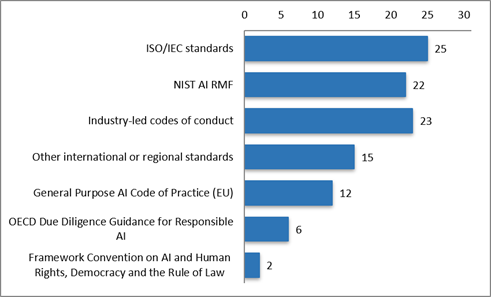
Almost all organisations also draw on international standards, frameworks and tools. Thirty use or contribute to the development of international technical standards, best practices or tools for risk identification and evaluation. ISO/IEC standards are the most frequently cited, followed by the NIST AI Risk Management Framework and industry-led codes of conduct. Twelve organisations based in Canada, Germany, India, Japan and the United States, refer to the EU General-Purpose AI Code of Practice and six to the OECD Due Diligence Guidance for Responsible AI (Figure 4). A similar pattern appears in responses related to risk management and governance, with ISO/IEC standards most frequently cited, followed by the NIST AI Risk Management Framework, the OECD AI Principles and industry-led codes of conduct.
Figure 4. Reference frameworks used for the identification, assessment and evaluation of AI related risks
When do AI risks become unacceptable?
Shared reference points do not mean identical risk thresholds. The framework asks organisations how they define the point at which a risk becomes unacceptable unless mitigated. The free-text answers point to three main approaches. These are not mutually exclusive, and many organisations combine them.
- The first, used by four frontier model developers, relies on capability thresholds as the trigger for this assessment. These organisations define in advance the model capabilities at which a model may pose a risk of severe harm, such as substantially increasing the ability to develop or use chemical, biological, radiological or nuclear weapons, advanced cyber-offence or a loss of human control. Reaching a threshold does not in itself make a risk unacceptable: it can signal when additional safeguards are warranted, and the risk is treated as unacceptable if these cannot mitigate it sufficiently. Responses include stronger safeguards before deployment, gated launches or even pausing development, with review by senior leadership or advisory bodies. Six respondents explain that capability thresholds are designed for frontier developers and do not fit their activities.
- The second approach is driven by regulation. Eight organisations classify their systems according to legally defined risk categories, most often those of the EU AI Act, and governance requirements follow from that classification. For most of these organisations, regulation is a starting point that they combine with their own risk assessment.
- The third and most common approach, complementary to the two above, applies established risk management methods to AI. Roughly 17 organisations assess the likelihood and impact of potential harms in a specific deployment context and decide whether risks fall within acceptable tolerance levels.
Managing risks across the AI lifecycle
Twenty-eight of the 31 organisations report managing risks at multiple stages of the AI lifecycle. The practices they describe include assessing intended uses and potential harms at the design stage, checking data quality during development, and testing safeguards before deciding whether and how to release a system. Once systems are in use, organisations describe monitoring performance, reviewing incidents and gathering user feedback. Several report using these findings to update safeguards and refine the tests they run before future releases. The emphasis varies by role. Model developers describe testing model capabilities and safeguards, while deployers describe assessing suppliers and checking whether a system is suitable for its intended use.
Sharing risk information
Mechanisms for exchanging risk information are widespread. Twenty-two organisations (71 %) have channels for receiving reports of risks, incidents or vulnerabilities, and 20 of these share such information with others. Among those sharing information, reporting to regulatory authorities – where relevant – is most common (21), followed by sharing through partnerships governed by confidentiality agreements (18). Public sharing is less frequent (13).
Security
AI security depends on coordinated actions across the value chain and throughout the AI system lifecycle. As AI systems increase security dependencies across the value chain, operational resilience is shaped by the ability to govern and respond to security risks beyond organisational boundaries. At the same, organisations play different roles across the AI system lifecycle, as model developers, application developers, deployers, and each role is associated with different security risks and responsibilities. A forthcoming blog post on AI security will explore this topic.
Transparency
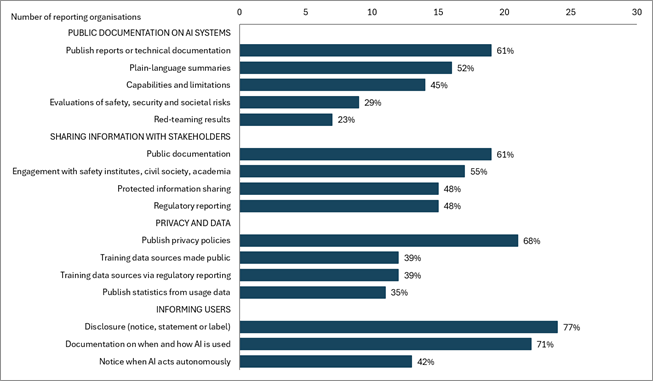
Twenty-four of the 31 organisations (74 %) tell users when they are interacting with AI, and 13 notify them when an AI system acts autonomously on their behalf (Figure 4). Nineteen publish documentation, covering capabilities, limitations and intended uses, technical documentation and risk management policies on their AI systems, but only nine publish evaluation summaries, and seven red-teaming and other testing results. Privacy policies are widely published, while fewer organisations disclose training data sources or statistics from usage data. Information is also shared through other channels, including direct engagement with AI safety institutes, civil society or academia, protected information sharing and regulatory reporting.
The reports therefore distinguish between several forms of transparency: informing users, publishing system documentation, and sharing evidence about risks with public or restricted audiences. These different forms of transparency will be explored further in a forthcoming blog post.
Figure 5. Transparency and information-sharing practices reported by organisations
Governance and accountability
Responsibility for AI risk management is generally assigned at a senior level. Twenty-seven organisations report executive oversight, 25 report oversight by senior management and 23 have a dedicated governance council or committee. Fifteen report oversight by the board of directors, and seven by an independent advisory body.
Staff training is also widespread: Thirty organisations train relevant staff on governance policies and risk management practices,
The framework also invites organisations to estimate the staff time and costs associated with compliance. Only seven responded. Reported staffing estimates range from half to one full-time equivalent in smaller organisations to 10–15 full-time equivalents, with contributions spread across some 100 staff, in one large organisation. The limited number of responses makes it difficult to draw broader conclusions about resource requirements.
Content authentication and provenance
The use of provenance mechanisms is concentrated among organisations that generate content. Fourteen of the 31 organisations use content provenance detection, labelling or watermarking, while nine consider such mechanisms not applicable. Of these 14, ten use visible labels, seven provide tools to detect hidden provenance signals such as watermarks, six embed hidden provenance information and six apply international or industry standards such as those of the Coalition for Content Provenance and Authenticity (C2PA). Twelve of the 14 collaborate on or invest in research on content authentication and provenance.
Research and broader impacts
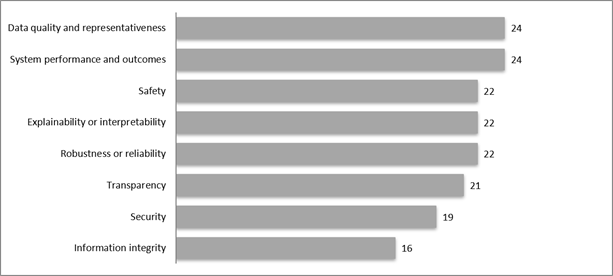
Reporting organisations describe a broad research agenda that extends beyond AI performance to its wider effects on people and society (Figure 5). Data quality and representativeness (24), alongside system performance and outcomes (24), are the most commonly reported research areas, followed closely by safety, explainability and robustness (22). More than half of reporting organisations also conduct research on security (19) and information integrity (16).
Figure 6. AI research areas reported by organisations
Research on AI’s broader impacts is also widespread: 22 organisations address socio-economic considerations, such as productivity and employment, and 20 examine environmental considerations, including energy use. Beyond research, 28 support digital literacy, education or training initiatives, and 25 pursue AI projects intended to deliver societal or public benefits.
What do these early findings tell us?
These findings illustrate the value of a common international reporting framework. By making organisations’ approaches to risk management visible and comparable, it shows where practices converge and where they differ, and where gaps remain. Importantly, it allows organisations to learn from one another.
With participation now spanning frontier developers, sector-specific users and small enterprises, HAIP 2.0 offers a broader view of how international AI governance commitments are put into practice across the AI lifecycle.

From the AI Wonk

From dialogue to delivery: making AI governance work in Southeast Asia
November 19, 2026 —  6 min read