

























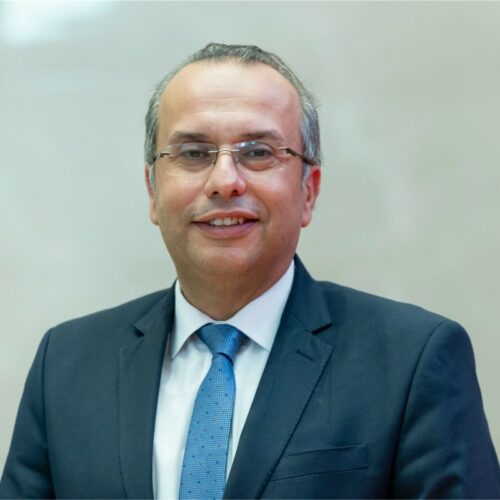
Ahmed Said
- Head of Sector, Policies and International Affairs at the National Telecom Regulatory Authority (NTRA) of Egypt and Advisor on economic and statistical affairs to the Minister of Communications and Information Technology (MCIT)
Ahmed Said is Head of Sector, Policies and International Affairs at the National Telecom Regulatory Authority (NTRA) of Egypt and Advisor on economic and statistical affairs to the Minister of Communications and Information Technology (MCIT).
Before that he was Executive Director of International Policies at NTRA and Head of Economic Affairs at NTRA, where was responsible for carrying out all the economic related activities in the telecom sector and monitoring the performance of the telecom market and the progress in implementing the cost modeling process and the financial related issues.
Mr. Said has been the Chairman of ITU-T Study Group 3, where he is leading the work on many topics like OTT, Mobile Financial services and alternative calling procedures, and the Arab Regional Group of Study Group 3.
Mr. Said started his career in Mobinil (the first mobile network operator in Egypt), followed by TheWayOut (Regional ISP head quartered in Egypt) whereby he reached the position of the business development manager. In 2002 Mr. Said moved to General Dynamics (U.S. based Corporation) as eGovernment and eBusiness consultant. In 2007 Mr. Said joined the National Telecom Regulatory Authority (NTRA) as the economic affairs director. Throughout his career at NTRA he gained extensive experience in the field of telecommunications regulations, cost modeling, regulatory economics and Market analysis
Mr. Said received his Master of Science in Business Information Technology from University of Middlesex in London, in the year 2001 and he obtained his Bachelor of Commerce in Accounting, from Cairo University in the year 1999.
Disclaimer: The opinions expressed and arguments employed herein are solely those of the authors and do not necessarily reflect the official views of the OECD, the GPAI or their member countries. The Organisation cannot be held responsible for possible violations of copyright resulting from the posting of any written material on this website/blog.