AI Systems Accelerate Cybersecurity Risks and Real-World Incidents

Thumbnail Image

The information displayed in the AIM should not be reported as representing the official views of the OECD or of its member countries.

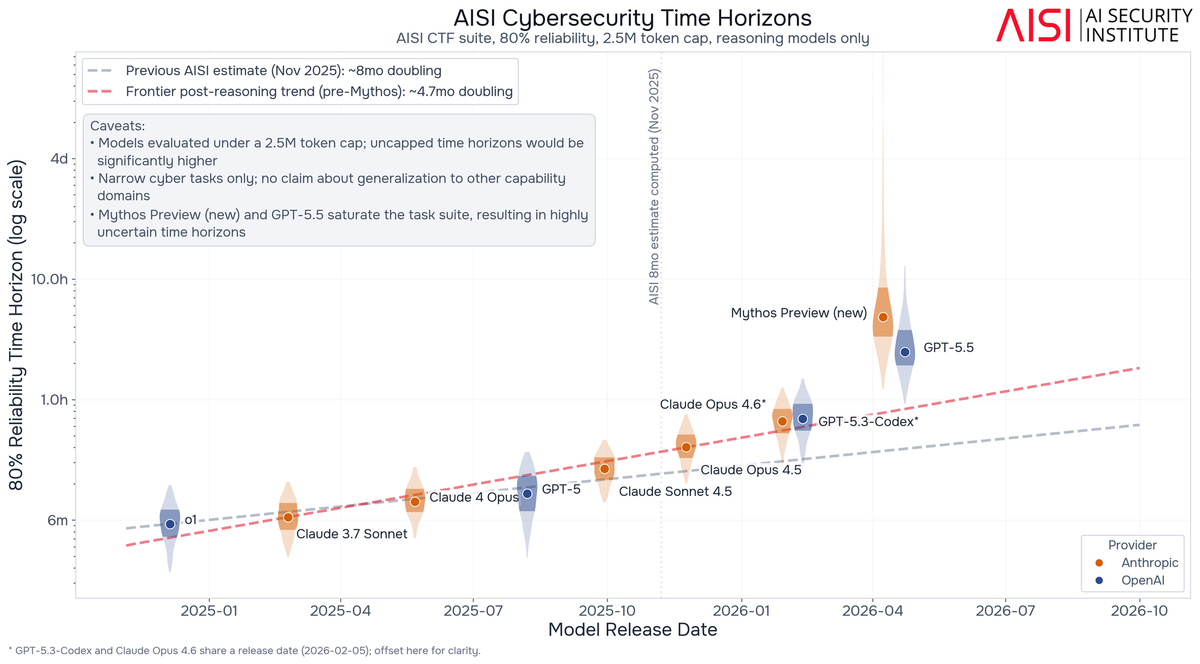
AI models such as Microsoft's MDASH, Anthropic's Mythos, and OpenAI's GPT-5.5 are rapidly advancing in autonomously finding and exploiting software vulnerabilities, leading to both the discovery of new security flaws and increased risks of AI-enabled cyberattacks. Authorities and experts warn of urgent threats to critical infrastructure, especially in Europe.[AI generated]

Why's our monitor labelling this an incident or hazard?

The article involves an AI system (Anthropic's Mythos) and discusses its development and use in cybersecurity tasks. However, it does not report any direct or indirect harm resulting from the AI's deployment or malfunction. The focus is on capability improvements and potential implications, which aligns with a plausible future risk rather than an actual incident. Therefore, this event fits the definition of an AI Hazard, as the AI system's rapid advancement in cybersecurity tasks could plausibly lead to incidents in the future, but no harm has yet occurred or been reported.[AI generated]

AI principles
Robustness & digital securitySafety

Industries
Digital securityGovernment, security, and defence

Affected stakeholders
GovernmentGeneral public

Harm types
Public interest

Severity
AI hazard

Business function:
ICT management and information security

AI system task:
Reasoning with knowledge structures/planning


Articles about this incident or hazard

Thumbnail Image

Anthropic's Mythos is evolving faster than expected, reports AI safety agency

2026-05-14
ZDNet
Why's our monitor labelling this an incident or hazard?
The article involves an AI system (Anthropic's Mythos) and discusses its development and use in cybersecurity tasks. However, it does not report any direct or indirect harm resulting from the AI's deployment or malfunction. The focus is on capability improvements and potential implications, which aligns with a plausible future risk rather than an actual incident. Therefore, this event fits the definition of an AI Hazard, as the AI system's rapid advancement in cybersecurity tasks could plausibly lead to incidents in the future, but no harm has yet occurred or been reported.
Thumbnail Image

Claude Mythos and GPT-5.5 have confirmed what researchers feared most about AI and cybersecurity

2026-05-14
Digit
Why's our monitor labelling this an incident or hazard?
The article explicitly involves AI systems (Claude Mythos Preview and GPT-5.5) performing autonomous cybersecurity tasks such as exploitation and reverse engineering. While no actual harm has yet occurred, the report warns that these AI capabilities could plausibly lead to real-world cyber incidents, including attacks on enterprise networks. This fits the definition of an AI Hazard, as the development and use of these AI systems could plausibly lead to harm (disruption of critical infrastructure or harm to organizations) in the future. There is no indication that harm has already occurred, so it is not an AI Incident. The article is not merely complementary information about AI governance or responses, but a direct assessment of a credible emerging risk from AI capabilities.
Thumbnail Image

AI models are getting better at replacing cybersecurity pros on certain tasks

2026-05-14
TheRegister.com
Why's our monitor labelling this an incident or hazard?
The article focuses on measuring and reporting the accelerating capabilities of AI models in cybersecurity tasks, which is a significant development in the AI ecosystem. However, it does not describe any realized harm, misuse, or malfunction of AI systems causing injury, rights violations, or disruption. Nor does it present a credible imminent risk or hazard from these capabilities. The discussion is about progress and potential, with no direct or indirect harm reported or clearly implied. Thus, it fits the definition of Complementary Information, providing context and updates on AI capabilities and their potential implications for cybersecurity, rather than describing an AI Incident or AI Hazard.
Thumbnail Image

Researchers say AI just broke every benchmark for autonomous cyber capability

2026-05-13
CyberScoop
Why's our monitor labelling this an incident or hazard?
The article explicitly discusses AI systems performing autonomous cybersecurity tasks, including vulnerability detection and exploitation, which qualifies as AI system involvement. However, no direct or indirect harm has occurred as a result of these AI systems; rather, the article focuses on the rapid capability growth and the potential for future AI-powered cyberattacks. This fits the definition of an AI Hazard, as the development and use of these AI systems could plausibly lead to AI incidents involving cyber harm. The article also includes recommendations for mitigation, reinforcing the focus on potential future harm rather than realized harm.
Thumbnail Image

OpenAI's GPT-5.5-Cyber Matches Claude Mythos in Security Tests

2026-05-14
WinBuzzer
Why's our monitor labelling this an incident or hazard?
The article centers on benchmarking AI models for cybersecurity tasks and discusses potential risks and access restrictions, but it does not describe any event where the AI systems directly or indirectly caused harm or security incidents. There is no indication of realized injury, rights violations, infrastructure disruption, or other harms. The discussion of restricted access and cautious deployment reflects a governance or risk management perspective rather than an incident or hazard event. Therefore, this is best classified as Complementary Information, providing context and updates on AI system capabilities and governance without reporting a new AI Incident or AI Hazard.
Thumbnail Image

ECB: AI Means European Banks Must Hasten Cybersecurity Pace

2026-05-14
DataBreachToday
Why's our monitor labelling this an incident or hazard?
The article does not describe a realized harm or incident caused by AI systems but rather warns about the plausible and imminent risk of AI-enabled cyberattacks on European banks and critical infrastructure. The involvement of AI systems is explicit, focusing on their use in cyberattacks and vulnerability exploitation. Since the harm is potential and the article urges proactive measures to prevent such harm, this fits the definition of an AI Hazard. There is no report of actual harm or breach yet, so it is not an AI Incident. The article is not merely complementary information about AI developments or governance responses but centers on the credible threat posed by AI cyber capabilities, qualifying it as an AI Hazard.
Thumbnail Image

AI cyber capability is speeding past earlier projections - IT Security News

2026-05-14
IT Security News - cybersecurity, infosecurity news
Why's our monitor labelling this an incident or hazard?
The article discusses the development and increasing capability of AI systems in cybersecurity tasks, which could plausibly lead to AI incidents such as cyberattacks or disruptions if misused or malfunctioning. Since no actual harm or incident is reported, but the potential for harm is credible and highlighted by the AI Security Institute's benchmarks, this qualifies as an AI Hazard rather than an AI Incident or Complementary Information. It is not unrelated because it directly concerns AI system capabilities with implications for harm.
Thumbnail Image

AI is getting better at security - and it's doing it faster than expected

2026-05-14
IT Pro
Why's our monitor labelling this an incident or hazard?
The article explicitly involves AI systems improving in cybersecurity tasks, including offensive ones, which can be reasonably inferred to involve AI systems performing complex autonomous or semi-autonomous actions. Although no actual harm or incident is described, the article emphasizes the credible risk of AI-enabled cyberattacks becoming more prevalent and severe, constituting a plausible future harm. This fits the definition of an AI Hazard, as the development and use of these AI systems could plausibly lead to AI Incidents involving harm to critical infrastructure or organizations. There is no indication of a realized incident or a governance or research update alone, so it is not an AI Incident or Complementary Information. It is not unrelated because the focus is on AI's impact on security risks.
Thumbnail Image

AI cyber skills now doubling in months, not years

2026-05-14
Metacurity
Why's our monitor labelling this an incident or hazard?
The article explicitly mentions AI systems (e.g., Microsoft's MDASH, Anthropic's Mythos, OpenAI's GPT-5.5-Cyber) autonomously finding software vulnerabilities and enabling patches for critical security flaws, which directly impacts cybersecurity and the protection of critical infrastructure. The involvement of AI in discovering and exploiting vulnerabilities, as well as the discussion of AI-enabled election interference and cybercrime, indicates realized harms or ongoing incidents related to AI use. The direct link between AI system use and cybersecurity vulnerabilities and their exploitation or mitigation fits the definition of an AI Incident, as it involves harm to critical infrastructure and potential violations of security and privacy rights. The article also discusses broader AI cybersecurity risks and geopolitical implications, but the primary focus is on realized impacts and ongoing incidents involving AI systems.