


















How quantum technologies could open new frontiers for AI





This three-part blog series explores the growing complementarity between artificial intelligence (AI) and quantum technologies. The first post introduced quantum technologies and outlined their strengths and the challenges of combining AI with quantum systems. The second examined how AI can support the development of quantum technologies, helping to optimise systems and accelerate progress towards practical applications. In this third and final instalment, we turn to the reverse relationship: how quantum technologies – including computing, sensing and communication – could support the future evolution of AI systems.
Although large-scale, fault-tolerant quantum computers remain a long-term goal, early-stage quantum devices and their integration with existing AI systems are already paving the way for quantum-enhanced AI. These developments could eventually lead to meaningful improvements across many sectors of the economy and in daily life.
What technical breakthroughs could quantum computing bring to AI?
In recent years, AI systems have become more powerful and data-intensive, particularly through large language models (LLMs). These developments have made the limitations of classical computing, especially in speed, energy consumption and scalability, increasingly apparent. Quantum technologies could offer a pathway to expand the frontiers of classical computing, potentially overcoming today’s computing bottlenecks. However, quantum computers are not expected to replace existing AI systems. They are likely to coexist, with quantum systems excelling at solving specific types of problems that are difficult or intractable for conventional computers.
As quantum computing evolves, it is expected to strengthen AI in two main ways. First, quantum computers could significantly improve energy efficiency. Training AI requires substantial computing resources that consume vast amounts of electricity, raising economic, energy security, and environmental concerns. This is particularly true of LLMs.
These pressures apply more broadly across statistical AI techniques, such as machine learning, where increasing model complexity and data intensity are pushing the limits of classical computing. This is often characterised by experts as the slowing of or end to Moore’s Law.
Second, quantum computing could enhance the performance and capabilities of AI systems. This has fuelled growing interest in quantum machine learning (QML), which refers to machine learning methods implemented using quantum algorithms. QML is expected to improve AI system learning performance in areas such as optimisation, pattern recognition and high-dimensional data analysis.
In the long term, QML may reduce the computational requirements and energy footprint of some AI workloads by performing complex computations more efficiently, although this remains to be demonstrated at scale. QML remains in an early stage of development and faces three key bottlenecks:
- Data transfer constraints: Moving large volumes of classical data (bits) into and out of quantum systems (qubits) remains slow, limiting the suitability for data-intensive AI tasks.
- Unproven advantage: Demonstrating performance gains over highly optimised algorithms on classical computers remains challenging.
- Unclear hardware requirements: Defining hardware specifications for QML, including qubit counts and coherence times, remains difficult, making it challenging to develop practical QML roadmaps.
For these reasons, experts do not expect widespread commercial QML applications within the next decade.
Near-term pathways to AI applications
While QML is a longer-term prospect, quantum-inspired AI techniques are already delivering practical benefits. These approaches adapt concepts from quantum physics for use on classical computing hardware. One prominent example is the use of tensor networks, originally developed to simulate quantum systems, to compress LLMs.
These techniques have significant practical implications for AI developers. As neural networks such as LLMs become larger and more complex, deployment is constrained not only by fixed hardware limits such as memory and processing capacity but also by the computational and energy costs of training and running these systems.
Tensor-network compression to reduce memory use
Some research has shown that tensor-network compression can reduce memory use and computational demands by 10-100x, often with only modest reductions in accuracy after fine-tuning. These efficiency gains enable advanced AI models to run on conventional CPUs, edge devices and legacy infrastructure, expanding access beyond specialised high-performance computing environments.
Because these techniques do not require quantum hardware, they are already being embedded in commercial applications. Startups and technology providers are offering tensor-network-based compression tools and positioning them as a path to lower costs and energy consumption while improving deployment flexibility.
In practice, quantum-inspired compression is best understood as complementary to established methods such as pruning and quantisation for optimising neural network efficiency. Because they target different forms of redundancy in neural networks, tensor approaches can be combined with conventional techniques and, in some cases, outperform them in both efficiency and performance. Together, these developments illustrate how insights from quantum information science are already shaping the evolution of AI, even before large-scale quantum computers become widely available.
Hybrid quantum-classical computing
The most realistic near-term pathway for combining AI with actual quantum computers is through hybrid quantum-classical systems that leverage the strengths of both AI and quantum computing. In these systems, quantum processors perform specific sub-tasks, such as optimisation or simulation, while classical AI models handle data processing, interpretation and control. In this direction, several computing infrastructures are integrating quantum processors into high-performance computing environments, enabling researchers and industry actors to experiment with quantum-enhanced AI workflows. At the same time, cloud-based quantum platforms are lowering access barriers, allowing AI developers to test quantum algorithms, such as optimisation or sampling routines, that can be integrated into machine learning workflows.
These advances could eventually translate into practical applications across multiple sectors. In materials science and chemistry, quantum computing combined with AI may accelerate the discovery of new materials and drugs by enabling more accurate simulations of molecular behaviour. In manufacturing and logistics, hybrid quantum-AI approaches could improve the performance of complex optimisation tasks such as scheduling, resource allocation and supply chain planning. Financial services actors are also exploring quantum-enhanced modelling for portfolio optimisation and risk analysis, where large combinatorial search spaces pose challenges for classical AI methods.
How could quantum sensing expand AI’s possibilities, and where?
Beyond computing, quantum technologies may also enhance AI through advances in sensing. Quantum sensors can detect extremely small changes in magnetic fields, temperature, motion, or chemical composition, often with higher precision, stability, or spatial resolution than classical devices, thereby producing novel data streams. For AI systems, access to richer and more accurate data can translate directly into new applications across multiple sectors.
In healthcare, more sensitive sensing technologies could enable earlier disease detection and more accurate monitoring of health indicators. By capturing subtle biological or chemical changes that might otherwise go unnoticed, quantum sensors could provide richer data for AI systems to analyse, supporting faster diagnosis and more personalised treatment decisions.
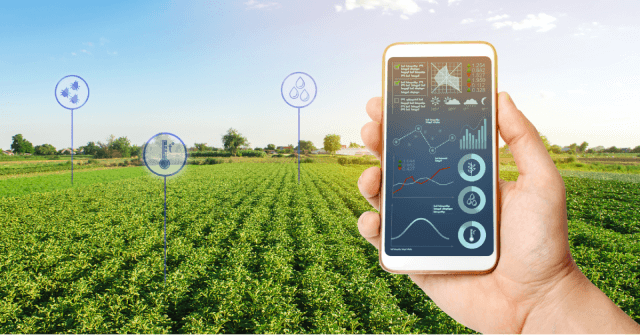
In agriculture, improved sensing precision may help monitor soil conditions, crop health and environmental variables in greater detail, allowing AI tools to optimise irrigation, fertilisation and resource use for higher yields and greater efficiency. Similar approaches could support environmental monitoring, in which higher data quality can strengthen forecasting models and inform policy responses to climate and sustainability challenges.
Quantum sensing also has potential applications in infrastructure and industry. Sensors capable of detecting minute physical changes could help identify early signs of structural stress or equipment degradation in bridges, transport systems or energy facilities. When combined with AI-driven predictive maintenance, this information could enable earlier interventions, reduce operational disruptions and improve safety outcomes. More broadly, the integration of advanced quantum sensing with AI highlights an important dimension of technological progress: improvements in data quality and reliability can be just as transformative as advances in computing capabilities.
How could quantum communication support AI?
Quantum communication could enable secure networking conditions for federated learning and multi-agent systems, where multiple devices collaboratively train models without sharing raw data. Quantum-secure communication channels could make it easier for different parties to share sensitive information (e.g., in healthcare, finance, or critical infrastructure) while reducing the risk of interception or data leakage, especially when training or inference occurs in distributed cloud environments. Research and patent applications are exploring whether entanglement-enabled networks or quantum-secured links could support distributed training architectures across geographically separated computing resources. Although these concepts remain largely experimental, early prototypes are already exploring secure distributed machine learning architectures built on quantum communication protocols.
Quantum communication may also become important for integrating AI with quantum sensing systems. Some advanced quantum sensors generate information directly in quantum states, which cannot always be measured or transmitted using conventional classical channels without losing valuable information. Quantum networking could allow these states to be transferred between devices or processing nodes while preserving their quantum properties, enabling more sophisticated analysis pipelines that combine sensing, computation and AI-driven interpretation.
Leveraging quantum and AI complementarities for a shared technological future
This three-part series examined the potential and challenges of combining AI and quantum technologies, from foundational concepts to emerging applications and future pathways. As we have seen, AI is also accelerating progress in quantum technologies themselves, for example, by improving calibration, noise reduction and experimental design. This bidirectional relationship (AI for quantum and quantum for AI) is likely to shape the next phase of innovation in both fields.
As outlined in this series, the integration of AI and quantum technologies could reshape scientific discovery, healthcare, industry and sustainability. At the same time, significant challenges remain, including technical limitations, talent shortages at the interface between the two technologies, ethical considerations and the need for international collaboration.
As we stand at the early stages of this transformation, one conclusion is clear: the digital future will not be built by AI or quantum technologies alone, but rather through their interplay and collaboration.
Learn more about the OECD work on quantum technologies: www.oecd.org/en/topics/sub-issues/quantum-technologies.html