Name in original language
Ciga Diário Intelligence
Initiative overview
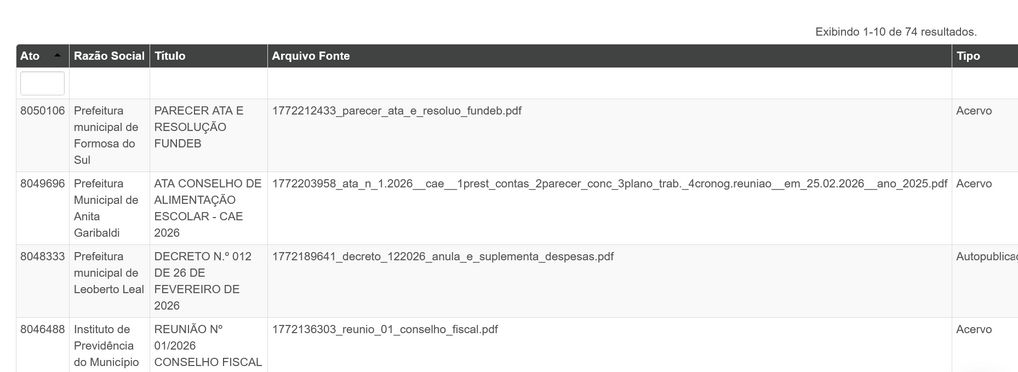
The Public Management Innovation Consortium (CIGA) operates the Municipal Official Gazette (Ciga Diário), a critical transparency tool for over 295 Brazilian municipalities. With more than 100,000 documents published annually by 4,500 different users, manual oversight of every publication was historically impossible. This high volume, combined with the stringent requirements of the Brazilian General Data Protection Law (LGPD) — which is closely modelled after the European Union's GDPR — created a significant risk of privacy breaches and administrative errors. CIGA Diário Intelligence was developed to bridge this gap, leveraging AI to provide a layer of security and intelligence that ensures transparency does not come at the cost of data privacy or legal integrity.
Although the Gazette system has successfully operated for over a decade, the integration of artificial intelligence in 2025 marked a transformative evolution. The initiative was catalysed by the need for regulatory compliance, a pro-innovation internal culture, and the increasing accessibility of high-quality AI models. The platform now operates across four strategic pillars: automated privacy analysis to detect sensitive data, AI-generated summaries to improve citizen accessibility, intelligent legislative compilation to track legal impacts, and content integrity monitoring. This shift from a simple PDF repository to an intelligent governance hub allows public managers to handle complex documentation with greater precision.
The impact of the initiative is already measurable, particularly in risk mitigation. Previously, responsibility for content accuracy rested solely on individual users, which occasionally led to the publication of incorrect or sensitive information. Today, AI provides real-time moderation. In a recent high-stakes incident, the system demonstrated its value by identifying and blocking malicious publications attempted by a hacker who had compromised user credentials. By acting as a proactive guardian rather than a reactive archive, the tool prevents legal and reputational damage to the municipalities, proving that AI-assisted oversight is essential for modern public administration.
Looking ahead, CIGA is focused on the full institutionalisation of these features. While malicious content detection is already active for all users, the remaining functionalities are being phased in, with the goal of 100% adoption by the end of 2026. The current strategic focus is the continuous refinement of these models to ensure maximum reliability and accuracy. By providing this technology as a shared service through a public consortium, CIGA demonstrates a scalable and sustainable model for how small and medium-sized municipalities can access cutting-edge AI tools to improve local governance without the need for individual high-cost investments.