






















Name in original language
Recomendação de Serviços Públicos
Initiative overview
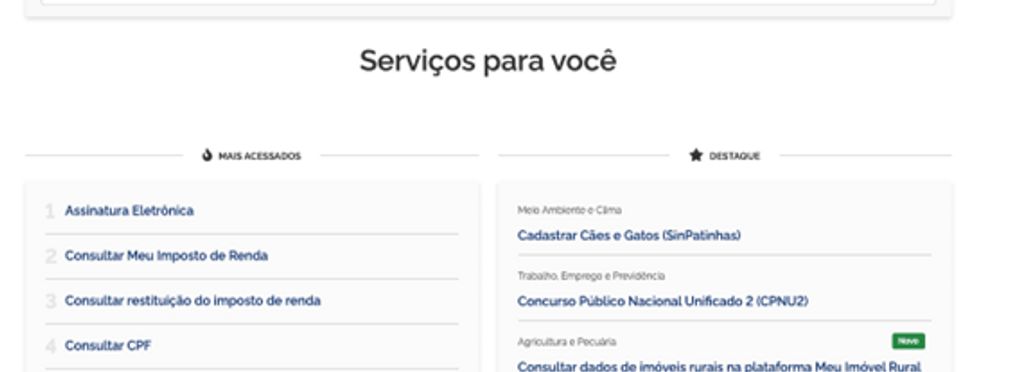
The initiative addresses the challenge of service discovery in large digital government portals. In the gov.br ecosystem, citizens face a catalogue of more than 5,000 public services delivered by multiple federal agencies, which historically made it difficult to identify the most relevant services for their needs.
The initiative applies artificial intelligence to analyse users’ navigation behaviour within the portal and their use of other federal digital public services. Based on these signals, the system recommends services in real time, embedded in the user journey. This reduces friction in navigation and supports a more intuitive and personalised experience for citizens seeking public services.
The initiative has been institutionalised as part of Brazil’s national digital government platform and is continuously improved through iterative model updates and monitoring of user-interaction metrics. Over time, the solution is expected to evolve by incorporating additional behavioural signals and improved semantic understanding of services, while maintaining alignment with data-protection, privacy and transparency requirements.
The architecture is designed to be scalable across federal services and replicable for other public-service portals.
Results, outcomes and impacts
The initiative has improved service discovery and user experience. On average, recommended services are accessed around 4.5 million times per month. In the last six months, the most frequently accessed service through the recommendation feature was the document-signing service.
Because recommended services are more contextualised for users, the conversion rate for starting a service is higher than the portal average, reaching 73.82%. Results are monitored using portal analytics, access logs and service-start metrics.
Challenges and lessons learned
Challenges include ensuring consistent metadata quality across more than 5,000 services, integrating data from multiple systems, and aligning AI-driven personalisation with privacy and data-protection requirements. Operational risks included biased recommendations and the underexposure of relevant but less frequently accessed services.
The initiative is evolving the AI model to improve relevance ranking and semantic understanding of public services, supported by iterative experimentation and continuous monitoring of user metrics. This requires data governance, controlled model updates with human oversight, and testing before wider rollout.
Lessons learned include the importance of data governance for service catalogues, transparent recommendation criteria, cross-agency coordination, and incremental deployment with continuous evaluation. Sustainability depends on high-quality service metadata, privacy-by-design, institutional ownership of the model and ongoing monitoring to mitigate bias and performance drift over time.