Turning AI ambition into action: How the OECD is engaging at India’s AI Impact Summit




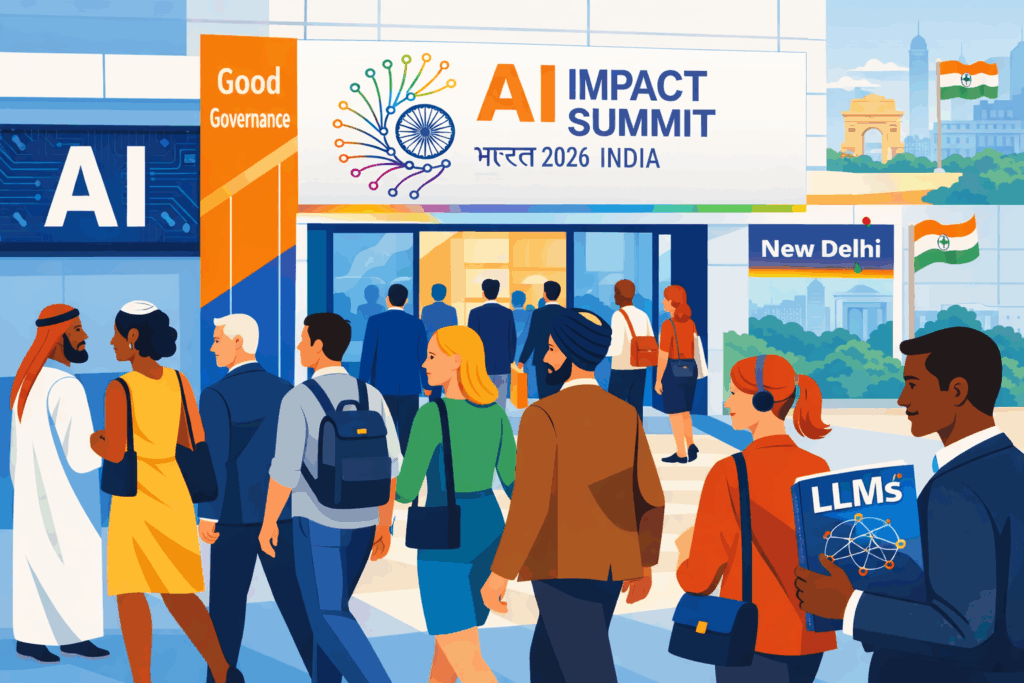
AI governance has entered a rapidly expanding phase. After defining values, principles and risk frameworks, policymakers and organisations of all sizes are confronting operational questions: how to ensure that principles are baked into practice at scale by deploying AI systems that benefit humanity in ways that are reliable, beneficial and accountable. This shift has shaped the OECD’s work on AI across multilateral and multi-stakeholder cooperation on issues including governance, tools, economic growth, data and skills over the past 10 years.
The India AI Impact Summit in New Delhi in February 2026 is a critical moment in that evolution. Following earlier global gatherings at Bletchley Park, Seoul, and Paris, the Impact Summit marks a clear shift toward focusing on how AI affects people’s lives. It is about delivery. It is about results. And it is about ensuring that AI serves people, is energy-efficient and drives progress for all our people.
That is why the OECD and GPAI are deeply engaged across the summit’s agenda, working with India and other partners to translate years of analysis, data and policy frameworks into tools that policymakers can use in practice to have real impact.
>>> Visit OECD.AI’s India Summit agenda<<<
The OECD at the India AI Impact Summit
Across the summit, the OECD will support this pragmatic approach with a series of events and deliverables. Here is a list of our main events. Details for the specific times and locations can be found on our main event webpage:
- Open-source tooling for safe, secure and trustworthy AI
17 February
This event will reiterate the global call for contributions to the OECD.AI Catalogue of Tools and Metrics, with a focus on underrepresented regions and languages. - Advancing AI transparency in practice,
17 February
This event is anchored in the Hiroshima AI Process reporting framework with a focus on how voluntary reporting, assurance mechanisms and shared templates can complement national initiatives. - The India Summit is an ideal setting to discuss AI incident monitoring and response
18 February
In this joint event by the Future Society and the OECD/GPAI, participants will focus on ensuring interoperable reporting and bridging perspectives and reporting frameworks between the Global North and South through tools such as the OECD AI Incidents Monitor. - The Council meeting of the Global Partnership on Artificial Intelligence (GPAI)
20 February
Co-Chaired by Korea and Singapore, this ministerial-level meeting offers an important opportunity for GPAI members to steer key projects and advance the partnership’s mission to implement human-centric, safe, secure and trustworthy AI, grounded in the OECD Recommendation on AI. Holding the Council meeting in New Delhi reinforces the strong alignment between GPAI’s work and the Summit’s focus on translating AI’s transformative potential into inclusive, people-centred outcomes. - AI for inclusive and resilient food systems
20 February
Thishigh-level event, co-hosted with the Government of the Netherlands, will focus on how AI can support sustainable, inclusive and trustworthy agricultural systems worldwide.
India’s AI moment
India’s hosting of the AI Impact Summit reflects a broader change in the global AI conversation. Debates on AI governance often centre on frontier models and long-term risks. These questions remain critical, and there are other immediate concerns as well: Will AI improve access to healthcare, education and public services? Will it raise productivity and create decent jobs in sufficient quantity?
India offers a particularly demanding environment for AI deployment. Scale, strong AI skills penetration, linguistic diversity and varying levels of infrastructure development mean that AI deployment and governance approaches must work under real-world constraints. This makes India a valuable reference point for policymakers interested in how AI systems perform outside research labs.
The Summit also comes at a moment when expectations for international co-operation are evolving. After the AI Action Summit in Paris in 2025, when attention turned to implementation mechanisms such as evaluations and incident reporting, India offers a platform to examine how these ideas can work in practice, particularly in countries at varying levels of economic development.
People, planet and progress
The India AI Impact Summit is structured around three pillars: People, Planet and Progress. These align closely with the OECD’s approach to trustworthy, human-centric AI, as reflected in the OECD AI Principles and the work of the Global Partnership on AI.
People sit at the centre of the agenda, from skills and labour markets to public services and user rights. India’s focus on “AI For All” in its national AI strategy and achievements in AI upskilling, show how targeted investments can broaden access to opportunity and support more inclusive growth. At the summit, the OECD will support the Human Capital Working Group with practical deliverables to help governments identify skills needs, address training gaps and monitor outcomes over time.
Our planet is increasingly impossible to ignore. AI’s energy and resource demands are growing, often in regions already under environmental stress. Responsible AI must therefore account for planetary limits. This is why discussions on efficiency, sustainability and the alignment of AI deployment with resource constraints and goals are crucial. The event AI for inclusive and resilient food systems, in partnership with and led by the Netherlands, exemplifies this approach by placing environmental resilience, data governance, and trust at the centre of AI deployment in food systems.
Progress is where the Summit can make its most distinctive contribution. Many governments are asking how to build, procure, evaluate and oversee AI in practice. The OECD’s tools and collaborative initiatives, many of which are available on OECD.AI, are designed to help answer these questions. We are bringing several of them to India to showcase, including the OECD.AI Catalogue of Tools & Metrics for Trustworthy AI and a new toolkit to help policymakers align their work with the OECD AI Principles.
What success might look like
The success of the India AI Impact Summit could help governments to clarify answers to practical questions: how to deploy AI responsibly in public services, how to develop AI skills at scale, how to manage risks and incidents, and how to ensure AI contributes to sustainable development rather than undermining it.
Most importantly, it should help rebalance the global AI conversation. By placing everyday impact and responsibility at the forefront, the summit recognises that the future of AI will be shaped not only in research labs and boardrooms, but also in classrooms, clinics, farms, and public administrations around the world.
Join us in Delhi
The OECD looks forward to working with India and international partners to make the India AI Impact Summit a milestone for global AI governance. We invite readers to visit the OECD.AI India AI Impact Summit agenda page to track all of our activities and engage with the discussions as they unfold.
Turning principles into practice is not easy. But it is essential. And in New Delhi this February, we have a real opportunity to move the global AI agenda forward together.


From the AI Wonk

Why insurance companies should encourage solid AI risk management instead of excluding it
December 17, 2025 —  5 min read