The European Union is deploying AI across strategic sectors







Across major economies, trustworthy artificial intelligence is rapidly moving from high-level policy to deployment in core industries such as health, manufacturing and mobility. The European Union is positioning itself for this shift by focusing not only on innovation capacity but also on trustworthy and coordinated implementation across its Member States. Gaining a deeper understanding of where AI is already being applied and gathering evidence on determinants of adoption are essential to assess Europe’s competitiveness and policy readiness.
The European Union is pursuing its ambition to become a global leader in trustworthy AI, moving from high-level policy to on-the-ground implementation. The OECD worked closely with the European AI Office to monitor efforts to develop trustworthy AI and promote its development across the European economy, with a two-volume publication series analysing how this transition is taking place in practice. The first volume focuses primarily on national strategies, initiatives and governance mechanisms for AI in EU Member States. The second, Progress in Implementing the European Union Coordinated Plan on Artificial Intelligence (Volume 2), shifts the lens to sector-specific impact.
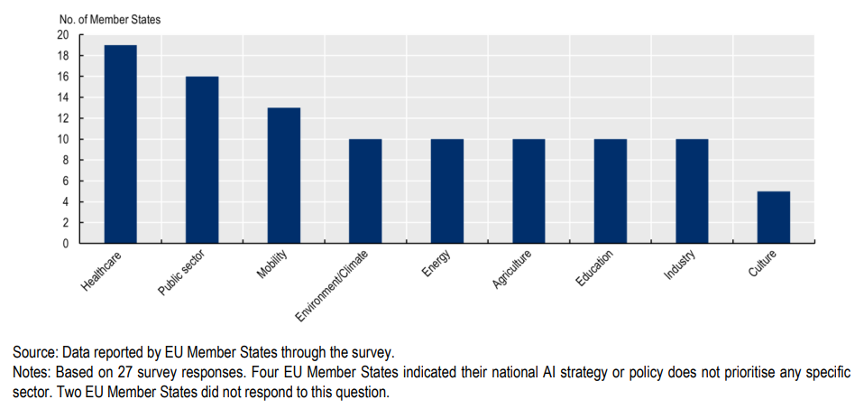
The report supports efforts by the European Commission and EU Member States to promote the development, deployment, and use of AI technologies across priority sectors. It draws on extensive multi-stakeholder engagement, including semi-structured interviews with industry experts and insights from dedicated stakeholder workshops. It focuses on concrete use cases that address specific needs in agriculture, healthcare, manufacturing and mobility, selected high-impact sectors where AI can contribute to digitalisation, sustainability and economic resilience. These sectors are most prominently featured across national AI strategies (Figure 1) as priority sectors for AI applications.
Agriculture: from precision to sustainability
Globally, agricultural producers are increasingly turning to AI-enabled precision tools to address labour shortages, environmental pressures and resource constraints. Within Europe, similar dynamics are shaping experimentation with AI-supported farming systems aligned with environmental targets under the European Green Deal.
As AI-driven solutions help optimise resources, reduce chemical inputs and maintain yields, the EU’s agricultural sector is exploring AI deployment to address structural workforce shortages and sustainability requirements. AI-powered agricultural robots and crop and soil monitoring systems are playing a growing role in improving resource efficiency.
Robs4Crops, for instance, illustrates how computer vision and sensor-based systems can enable autonomous mechanical weeding and spraying in vineyards, crop fields and apple orchards. AI4SoilHealth, in turn, is developing an open-access, AI-driven digital infrastructure to help assess and monitor soil health metrics across Europe.
At the same time, many initiatives remain at pilot or experimental stages. Limited digital infrastructure in rural areas, fragmented and inaccessible datasets (due to the resources required to collect high-quality, diverse data across crops, soil, and livestock, and to limited interoperability of existing public datasets), financial barriers, and uncertainty over return on investment continue to constrain large-scale adoption.
Healthcare: enhancing diagnostics and operations
Health systems worldwide are using AI to improve diagnostic accuracy and manage increasing service demand. In Europe, demographic ageing and workforce shortages are strengthening the case for deploying AI across both clinical and operational settings.
AI can help address rising costs and workforce shortages in healthcare while improving patient outcomes through faster and more accurate diagnostics.
One of the most impactful use cases is AI-enhanced medical imaging for the early detection of conditions such as cancer, supported by initiatives including the European Cancer Imaging Initiative. Similar approaches are already being deployed in the United States and Japan, where AI-assisted radiology is helping reduce diagnostic backlogs, highlighting the strategic importance of scaling comparable capabilities across Europe.
Beyond clinical care, the report explores how AI is improving hospital operations. Predictive and optimisation AI systems can help forecast patient inflows and manage bed occupancy, helping healthcare providers reduce staff pressure and waiting times. Perplex, an EU-funded initiative, illustrates how AI can help automate and optimise scheduling and resource management in the outpatient department of a hospital in Madrid.
Despite this potential, barriers such as fragmented health data environments and trust challenges remain significant constraints.
Manufacturing: the rise of industrial intelligence
Competitiveness in the manufacturing sector increasingly depends on integrating AI into production systems, supply chains, and quality control processes. While other major economies are accelerating investment in smart factories, adoption across Europe remains uneven.
AI adoption in EU manufacturing remains modest and highly fragmented, with pharmaceuticals and electronics leading the way, while traditional industries such as textiles and food processing progress more slowly.
Despite these differences, there are areas where AI could have a substantial impact. The report highlights three priority use cases: predictive maintenance, quality assurance and control, and supply chain optimisation.
Predictive maintenance systems, such as those developed through the Made in Europe Partnership, analyse sensor data to forecast equipment failures and reduce costly downtime. In quality control, AI-powered inspection improves efficiency by identifying defects in real time. Comparable smart-manufacturing deployments in East Asia and the United States demonstrate how scaling such applications can strengthen productivity growth and industrial resilience.
Mobility: navigating toward a connected future
Transport systems are becoming increasingly data-driven as cities and logistics operators deploy AI to improve safety, efficiency and sustainability. Across Europe, mobility-sector deployment is closely linked to broader digital and climate transition strategies.
AI can help transport and mobility systems become safer, more efficient and more sustainable. AI-enabled traffic management systems, such as those explored in the AI4Cities project, can reduce congestion by dynamically adjusting traffic-light patterns. Automated driving technologies and intelligent freight logistics systems can further optimise routes and scheduling efficiency. Here, the EU Connected, Cooperative and Automated Mobility (CCAM) Partnership aims to accelerate the transition from research prototypes to real-world applications.
These developments are intended to align with the Sustainable and Smart Mobility Strategy, although gaps in infrastructure readiness and investment capacity remain important constraints for many operators.
Overcoming barriers to scale
Progress in Implementing the European Union Coordinated Plan on Artificial Intelligence (Volume 2) demonstrates significant sectoral potential for AI deployment, while identifying persistent bottlenecks that continue to slow implementation. Addressing these constraints will be critical to moving from experimentation with pilots to widespread deployment that fundamentally transforms the European economy for the better. To do so, the report puts forward a number of key recommendations, including the following:
- Focus on concrete sector-specific AI use cases
Targeted policies, investment, and collaboration will be essential to unlock AI’s full potential in key sectors of the EU’s economy. Public-private-academic partnerships, open innovation platforms, and cross-border collaborations can accelerate AI development and adoption, particularly when grounded in sector-specific needs. Focusing on concrete AI use cases, building ownership and trust through transparency and co-design with end-users, and demonstrating tangible benefits will be key to ensuring that AI strengthens Europe’s economic competitiveness, sustainability, and societal well-being.
- Strengthen data foundations
Investing in high-quality datasets, common standards and shared governance frameworks can enable secure, privacy-preserving data sharing across borders and sectors. Improving data representativeness and reducing fragmentation will lower entry barriers and support downstream AI adoption.
- Expand infrastructure and compute capacity
Investments in broadband connectivity, cloud and edge computing, 5G networks and AI compute environments—including AI factories and high-performance computing centres—are essential to bridging regional gaps. Initiatives such as EuroHPC are helping ensure that economic actors, including SMEs, can access the computational resources required to train and deploy advanced AI models.
- Close the skills and talent gap
Unlike their larger counterparts, who tend to have more resources at their disposal, smaller firms and public organisations require access to technical expertise and sector-specific training before large-scale deployment of AI becomes feasible. European Digital Innovation Hubs (EDIHs) are supporting this process through a “test before invest” approach that lowers adoption risks.
- Enhance trust and regulatory coordination
Regulatory sandboxes allow firms to test innovative AI applications under supervisory conditions, enabling regulatory learning and improving compliance readiness before market entry. Providing clearer guidance and harmonising regulatory interpretation across Member States will remain particularly important for start-ups and SMEs operating under the EU AI Act, alongside relevant existing rules such as the GDPR.
Many of the report’s findings align with the European Commission’s Apply AI Strategy, which focuses strongly on accelerating adoption and the active deployment of AI across the economy. The OECD and the European Commission will continue working together to support implementation of the Strategy and to ensure that lessons from European AI deployment experiences contribute to the broader global AI policy community.
The authors would like to thank John Leo Tarver for his contributions to this report series and blog posts.