






















Name in original language
統合イノベーション戦略
Initiative overview
Japan’s Integrated Innovation Strategy is an annual, Cabinet‑level plan published every year since 2018. It was created to replace the earlier Science and Technology Innovation Comprehensive Strategy (2013–2017) after the government determined that past approaches were insufficient for global competitiveness. The reform introduced a continuous, end‑to‑end innovation strategy—spanning basic research through social implementation—coordinated by the Council for Science, Technology and Innovation (CSTI) within the Cabinet Office. Eight editions have been issued to date (2018–2025), each approved by formal Cabinet decision. The 2018–2020 editions implemented the 5th Science and Technology Innovation (STI) Basic Plan, while the 2021–2025 editions function as annual implementation plans under the 6th Basic Plan.
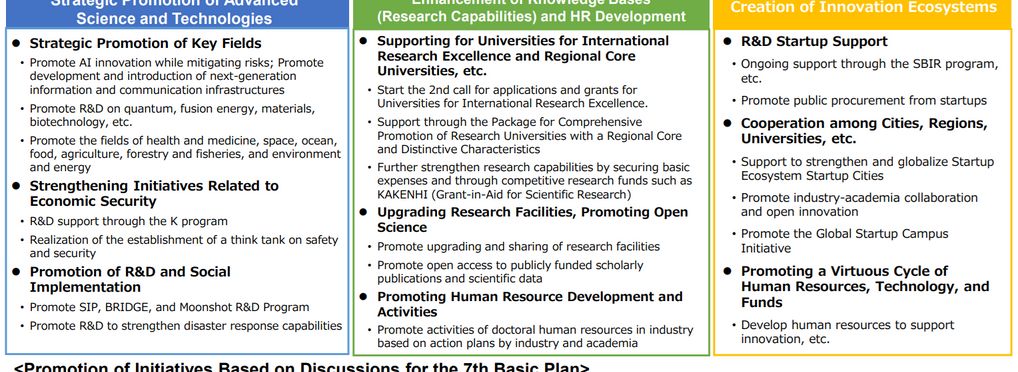
Each annual edition is structured around three consistent pillars that have evolved over time: the strategic promotion of advanced science and technologies; strengthening the knowledge base and human resource development; and the creation of innovation ecosystems. The first pillar covers priority technologies such as AI, quantum, biotechnology, materials science, fusion energy, and semiconductors. The second includes measures such as the 10‑trillion‑yen university endowment fund to enhance research capacity. The third focuses on expanding startup support and mobilising public–private R&D investment. Artificial intelligence has been a central theme across all editions, with emphasis intensifying in recent years. The 2024–2025 strategies incorporated the AI Promotion Act, economic security considerations, and international governance cooperation through the Hiroshima AI Process.
Cross‑government coordination is ensured through the Integrated Innovation Strategy Promotion Council, which convenes seven major “command‑tower” bodies: CSTI, the Digital Society Promotion Council, the Intellectual Property Strategy Headquarters, the Health and Medical Strategy Promotion Headquarters, the Space Development Strategy Headquarters, the AI Strategic Headquarters (established in 2025), and the Comprehensive Ocean Policy Headquarters. Under the 6th Basic Plan, Japan set a combined public–private R&D investment target of 120 trillion yen for FY2021–FY2025.
Results, outcomes and impacts
Government R&D investment over FY2021–2025 reached approximately 40 trillion yen, exceeding the 30-trillion-yen target. The FY2025 science and technology budget exceeded 5 trillion yen for the first time. National AI R&D spending in FY2024 raised to 23.79 trillion yen recording the highest ever figures. Key institutional milestones include the Japan AI Safety Institute (2024), the AI Promotion Act and AI Strategic Headquarters (2025), and the 10-trillion-yen university endowment fund.