Name in original language
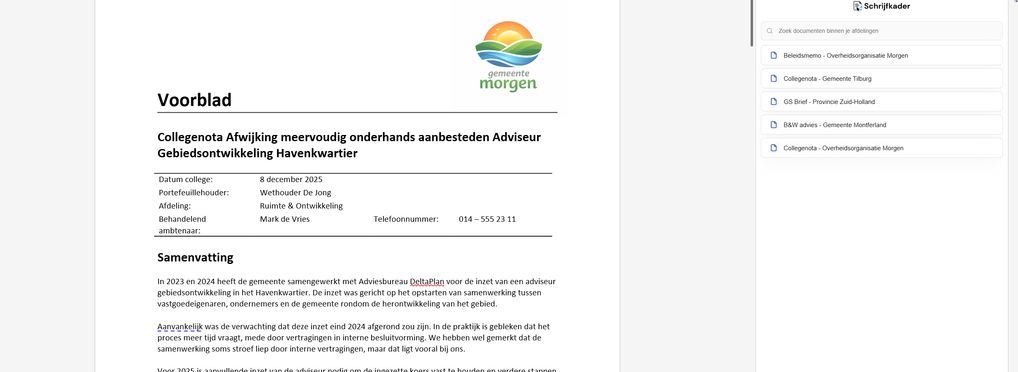
Schrijfkader
Initiative overview
Governments rely heavily on written documents for policymaking, decision-making and communication with citizens. Civil servants spend significant time drafting policy proposals, council documents, internal reports and formal correspondence. These documents must follow strict administrative and legal standards while remaining clear and understandable for decision-makers and the public.
Schrijfkader was developed to support civil servants in this process by providing AI-assisted writing support directly within Microsoft Word. The tool offers contextual suggestions while documents are being written and helps users improve structure, clarity and tone. It can also support compliance with organisational writing frameworks and legal communication standards used by public administrations.
The initiative was co-developed with the Municipality of Tilburg and further refined in collaboration with the Province of South Holland and other Dutch public sector organisations. Development focused on building a practical solution that integrates into existing government workflows rather than requiring new systems or complex changes to existing processes. Human oversight remains central: the tool provides suggestions, while civil servants remain fully responsible for decisions and final content.
The initiative aims to reduce administrative workload, improve the readability and consistency of government documents, and support more transparent communication with citizens. As adoption expands, the approach demonstrates how AI can support everyday administrative tasks within government in a responsible and practical manner.
Schrijfkader continues to evolve as additional public organisations participate and new functionalities are introduced. Because the tool is designed to integrate with commonly used software and organisational writing frameworks, the approach has strong potential to scale to other governments facing similar challenges in administrative writing and document production.
Results, outcomes and impacts
Early implementations suggest that Schrijfkader can significantly reduce the time required to draft and revise government documents while improving clarity and consistency. Users report fewer editing cycles and improved adherence to organisational writing guidelines. The tool is currently implemented or piloted across multiple Dutch public sector organisations. Initial evaluations rely on user feedback, document quality reviews and time-saving estimates. As adoption expands, further evaluation will focus on measurable indicators such as drafting time reduction, document readability improvements and productivity gains for civil servants.