






















Name in original language
行政における生成AIの適切な利活用に向けた技術検証
Initiative overview
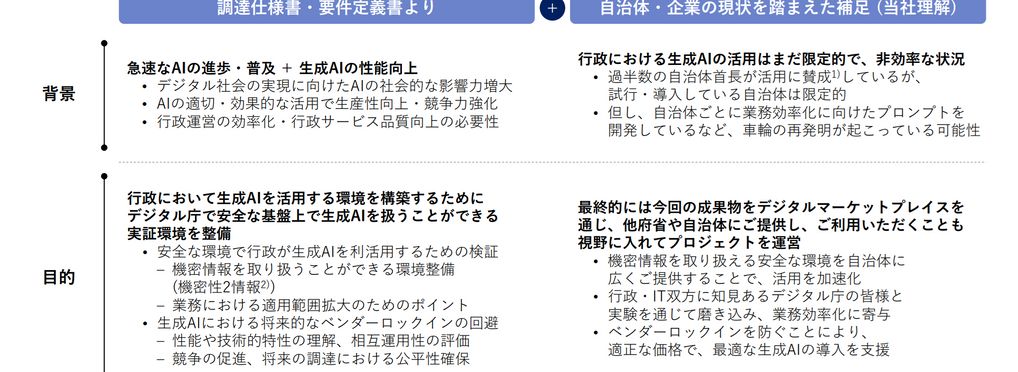
Japan's Digital Agency launched this technical verification project in response to the Cabinet-approved Priority Plan for the Realization of a Digital Society (June 2022), which called on the government to assess AI's potential while identifying associated risks. As generative AI tools such as large language models advanced rapidly through 2023, the government convened discussions at the Council for the Promotion of a Digital Society and decided to move from policy deliberation to hands-on experimentation.
The pilot ran from December 2023 to March 2024 and targeted staff at the Digital Agency and selected officials in other central ministries and local governments. Participants accessed a purpose-built web application offering a chat interface connected to multiple large language models. The pilot pursued two parallel tracks:
- (1) an open-ended business improvement validation, where officials freely applied generative AI to their daily tasks and reported results via surveys;
- and (2) targeted use case validations, where specific administrative workflows were tested systematically, including public comment processing, legislative drafting support, document summarisation, and code generation.
The Digital Agency published a comprehensive 325-page results report, a CSV of sample prompts, and test case examples in May 2024. It also distilled findings into a three-part “10 Lessons Learned” blog series. The pilot directly informed FY2024 follow-up activities, including an AI Ideathon/Hackathon and the development of the “Gennai” government AI platform, which was rolled out to all Digital Agency staff in May 2025 and is now being expanded to all central ministries.
Results, outcomes and impacts
Survey results showed that frequent users of generative AI reported both efficiency gains and quality improvements. Notably, quality improvements exceeded expectations more than efficiency gains alone. The pilot found generative AI effective not only for "writing" but also for "reading" tasks such as summarising and reviewing documents. The FY2024 continuation scaled the effort: by February 2025, the platform reached 134 average weekly users, 1,877 average weekly API requests, and 85 cumulative AI applications created. 10% of surveyed users built their own AI applications, and 70% of teams receiving expert support became operational. The pilot's findings directly shaped national guidelines DS-920 issued in May 2025.