


The article does not report a realized harm or incident caused by AI notetakers but focuses on the potential risks and uncertainties related to their use, especially regarding data privacy and confidentiality. These concerns indicate a credible risk that the AI systems' development and use could plausibly lead to harms such as violations of rights and breaches of confidentiality. Therefore, the event fits the definition of an AI Hazard, as it describes circumstances where AI systems could plausibly lead to harm, but no direct or indirect harm has yet been reported.[AI generated]

AIM: AI Incidents and Hazards Monitor
Automated media discourse monitor of AI incidents and hazards (Beta)
AI-related legislation is gaining traction, and effective policymaking needs evidence, foresight and international cooperation. The OECD AI Incidents and Hazards Monitor (AIM) documents AI incidents and hazards to help policymakers, AI practitioners, and all stakeholders worldwide gain valuable insights into the risks and harms of AI systems. Over time, AIM will help to show risk patterns and establish a collective understanding of AI incidents and hazards and their multifaceted nature, serving as an important tool for trustworthy AI. AI incidents seem to be getting more media attention lately, but they've actually gone down as a share of all AI news (see chart below!).
The information displayed in the AIM should not be reported as representing the official views of the OECD or of its member countries.
Advanced Search Options
As percentage of total AI events
Show summary statistics of AI incidents & hazards
AI Notetakers Raise Privacy and Data Security Concerns in Meetings
AI notetakers, which transcribe and summarize virtual meetings, are raising concerns among professionals about privacy, data security, and potential legal breaches. Sensitive information, including confidential business data and personal details, may be stored or misused, leading to risks of unauthorized access and privacy violations.[AI generated]
AI principles:
Industries:
Affected stakeholders:
Harm types:
Severity:
Business function:
Autonomy level:
AI system task:
Why's our monitor labelling this an incident or hazard?

AI-Generated Fake Images Harm Shakira's Reputation
Colombian singer Shakira publicly denounced the circulation of AI-generated fake images depicting her in false scenarios and endorsing brands or political campaigns without her consent. These manipulated images have caused reputational harm and misinformation, prompting her team to take action to remove them.[AI generated]
AI principles:
Industries:
Affected stakeholders:
Harm types:
Severity:
Autonomy level:
AI system task:
Why's our monitor labelling this an incident or hazard?
The article explicitly states that AI-generated manipulated images are being disseminated, causing false narratives and reputational damage to Shakira. This constitutes harm to a person and communities through misinformation and unauthorized use of her image. The AI system's role is pivotal in creating these false images, making this an AI Incident under the definitions provided.[AI generated]

Italian Privacy Authority Fines Character.AI for Data Protection and Child Safety Failures
The Italian Data Protection Authority fined Character Technologies Inc., operator of Character.AI, €158,000 for multiple violations of data protection laws, including inadequate safeguards for minors, insufficient age verification, and delayed compliance with EU privacy requirements. The AI platform's management of user data and child safety was found lacking.[AI generated]
AI principles:
Industries:
Affected stakeholders:
Harm types:
Severity:
Business function:
AI system task:
Why's our monitor labelling this an incident or hazard?
Character.AI is an AI system (a generative conversational AI chatbot). The event involves the use of this AI system and its failure to adequately protect minors and comply with data protection laws, which are legal obligations protecting fundamental rights. The imposition of a fine by the privacy authority confirms that harm (legal violations) has occurred. This fits the definition of an AI Incident under category (c) violations of human rights or breach of obligations under applicable law intended to protect fundamental rights. The event is not merely a potential risk or a complementary update but a concrete sanction for realized legal violations linked to the AI system's use. Hence, the classification is AI Incident.[AI generated]
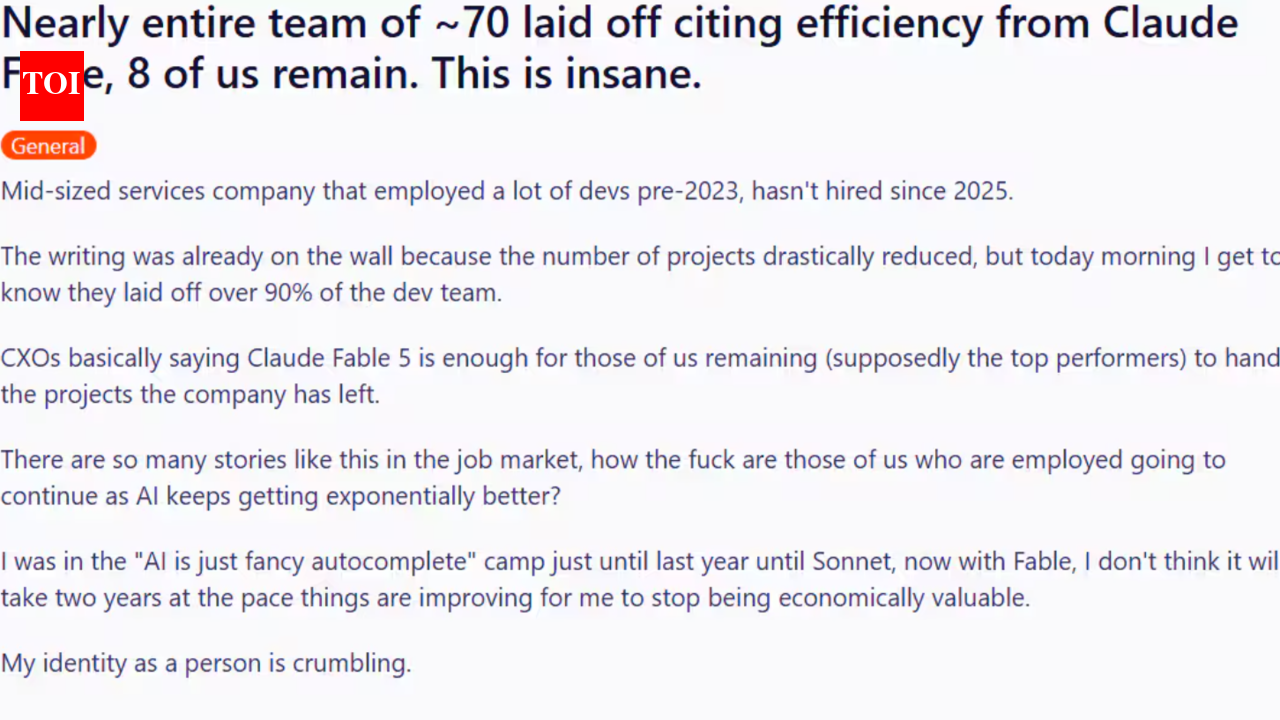
AI System Claude Fable 5 Leads to Mass Developer Layoffs at Software Company
A viral Reddit post claims a mid-sized software company laid off over 90% of its development team, citing efficiency gains from the AI system Claude Fable 5. Only eight developers remain, with executives stating the AI can handle most tasks. The incident has sparked debate about AI's impact on tech jobs.[AI generated]
AI principles:
Industries:
Affected stakeholders:
Harm types:
Severity:
Business function:
Autonomy level:
AI system task:
Why's our monitor labelling this an incident or hazard?
The event involves the use of an AI system (Claude Fable 5) that purportedly replaced most of the software development workforce, leading to layoffs. This constitutes a violation of labor rights and harm to employment, which fits the definition of an AI Incident. Although the information is unverified and anonymous, the description clearly links the AI system's use to realized harm (job losses). Therefore, it qualifies as an AI Incident rather than a hazard or complementary information.[AI generated]

Madison Square Garden's AI Surveillance System Secretly Profiles and Scores Celebrities
Madison Square Garden used AI-driven facial recognition and risk scoring systems to track, profile, and assign risk levels to thousands of celebrities and guests, including LGBTQIA individuals, based on personal attributes and social media activity. A database leak exposed these practices, raising concerns over privacy violations and discriminatory surveillance in New York.[AI generated]
AI principles:
Industries:
Affected stakeholders:
Harm types:
Severity:
Business function:
AI system task:
Why's our monitor labelling this an incident or hazard?
The event involves an AI system (facial recognition and risk scoring) used in surveillance and profiling, which directly led to harm through privacy violations and exposure of sensitive personal data after a data breach. The involvement of AI in tracking and labeling individuals with risk scores and sensitive attributes, combined with the leak of this data, constitutes a violation of human rights and privacy. This meets the criteria for an AI Incident as the AI system's use directly led to harm.[AI generated]

Physicians Over-Trust Faulty AI Recommendations in Clinical Decision-Making
A study in Spain found that over 200 physicians often trusted incorrect AI-generated treatment recommendations, even when patient recovery data contradicted the AI's advice. This overreliance on faulty AI outputs, despite evidence to the contrary, highlights significant risks to patient safety in clinical settings.[AI generated]
AI principles:
Industries:
Affected stakeholders:
Harm types:
Severity:
Autonomy level:
AI system task:
Why's our monitor labelling this an incident or hazard?
The event involves an AI system providing treatment sensitivity classifications that were inaccurate and ineffective. The clinicians' reliance on these faulty AI recommendations, despite contradictory patient recovery data, indicates that the AI system's use indirectly led to potential harm to patients' health. This fits the definition of an AI Incident because the AI system's use has directly or indirectly led to harm to persons (patients) through erroneous treatment decisions. The study's findings emphasize the real-world risk of harm from AI misuse or overreliance in healthcare, not just a hypothetical hazard or complementary information.[AI generated]

Ghanaian Influencer Extradited to US for AI-Driven $8M Romance Scam
Ghanaian influencer Frederick Kumi (Abu Trica) was extradited to the US for allegedly using AI tools to create fake online identities, defrauding elderly Americans of over $8 million through romance scams. US prosecutors claim AI-enabled deception was central to the financial harm caused to victims.[AI generated]
AI principles:
Industries:
Affected stakeholders:
Harm types:
Severity:
Autonomy level:
AI system task:
Why's our monitor labelling this an incident or hazard?
The article explicitly states that AI tools were used to create fake online identities, which were instrumental in the scam that defrauded elderly Americans of over $8 million. This use of AI directly led to significant harm to individuals, fulfilling the criteria for an AI Incident. The harm is realized (not just potential), involving violations of rights and financial harm to vulnerable groups. Hence, the event is classified as an AI Incident.[AI generated]

AI-Assisted Exploit Forces Secret Network Migration to Arbitrum
Secret Network suffered a $4.7 million bridge hack, with attackers leveraging AI tools to exploit vulnerabilities in aging blockchain code. In response, the team proposed migrating its SCRT token from Cosmos to Arbitrum, citing increased AI-driven security risks and requiring community approval for the move.[AI generated]
AI principles:
Industries:
Affected stakeholders:
Harm types:
Severity:
AI system task:
Why's our monitor labelling this an incident or hazard?
The article explicitly mentions that AI models have increased the ability to analyze and exploit old code, leading to a recent exploit causing a $4.7 million loss. This is a direct link between AI use and realized harm (financial loss) in a critical infrastructure-like system (blockchain bridges and smart contracts). The AI involvement is in the use phase, assisting attackers in exploiting vulnerabilities. The harm is financial loss to users and ecosystem disruption, which fits under harm to property and communities. Thus, the event meets the criteria for an AI Incident due to AI's pivotal role in enabling the exploit and consequent harm.[AI generated]

Mayo Clinic Sued for Retaliation After AI Compliance Whistleblower Raises Patient Safety Concerns
Traci Tamiko Eto, former Mayo Clinic Director of Research Operations, alleges she was retaliated against and fired after raising concerns about AI systems compromising patient privacy, data integrity, and research compliance. The lawsuit claims Mayo ignored federal safeguards, risking patient care and research integrity in Rochester, Minnesota.[AI generated]
AI principles:
Industries:
Affected stakeholders:
Harm types:
Severity:
Business function:
Why's our monitor labelling this an incident or hazard?
The article explicitly involves AI systems used in healthcare decision-making, which are central to the allegations. The lawsuit claims that safety and privacy standards were compromised, which could lead to faulty medical decisions (harm to health) and breaches of patient privacy (violation of rights). These harms fall under the AI Incident definition, as they are directly or indirectly caused by the development and use of AI systems. The presence of a lawsuit and specific allegations of misconduct and harm further support classification as an AI Incident rather than a hazard or complementary information. The event is not merely a potential risk but involves claims of actual harm or misconduct related to AI research and deployment.[AI generated]
NATO Develops AI-Driven 'Kill Web' for Eastern Flank Defense
NATO is developing the Eastern Flank Deterrence Initiative, an AI-powered network of sensors, drones, satellites, and autonomous systems along its eastern border to detect and rapidly respond to potential Russian attacks. The system enables real-time surveillance and automated military decision-making, raising concerns about the risks of autonomous lethal engagement.[AI generated]
AI principles:
Industries:
Affected stakeholders:
Harm types:
Severity:
Autonomy level:
AI system task:
Why's our monitor labelling this an incident or hazard?
The article explicitly describes an AI system (Palantir's Maven Smart System and other AI-enabled sensors, drones, and autonomous weapons) being developed and integrated into NATO's defense strategy to detect and engage enemy forces automatically. The AI's role is pivotal in decision-making and target engagement, which could lead to injury or death in conflict scenarios. However, the article does not report any actual harm or incident caused by these AI systems yet; it focuses on the development and intended use of these systems as a deterrent and defense measure. Given the credible risk of harm from autonomous lethal systems and AI-guided military operations, this event is best classified as an AI Hazard rather than an AI Incident. It is not Complementary Information because it is not a response or update to a prior incident but a description of a new AI-enabled military capability with potential for harm.[AI generated]

Meta's AI Uses Instagram Photos Without Explicit Consent, Raising Privacy Concerns
Meta's new AI models, Muse Image and Muse Video, use public Instagram photos to generate images without explicit user consent. Users are automatically opted in, and are not notified when their images are used. This has led to privacy violations, as withdrawal of consent does not remove AI-generated images.[AI generated]
AI principles:
Industries:
Affected stakeholders:
Harm types:
Severity:
Business function:
AI system task:
Why's our monitor labelling this an incident or hazard?
The event involves an AI system (Meta's Muse Image) that uses user photos from public Instagram accounts to generate images. The automatic opt-in without explicit user consent and lack of notification about usage constitutes a violation of users' rights and privacy, which is a breach of obligations under applicable law protecting fundamental rights. This meets the criteria for an AI Incident under the definition of violations of human rights or breach of legal obligations. Although no direct physical harm is reported, the infringement on privacy and consent is a significant harm. Hence, the event is classified as an AI Incident.[AI generated]
Madrid Man Arrested for AI-Related Online Fraud Scheme
Spanish police arrested a man in Madrid for running a decade-long digital fraud scheme, selling fake online courses, cryptocurrency investments, and AI products through fictitious companies and deceptive advertising. Victims suffered financial losses and intellectual property violations, with AI products central to the scam's recent operations.[AI generated]
AI principles:
Industries:
Affected stakeholders:
Harm types:
Severity:
Why's our monitor labelling this an incident or hazard?
The event involves the use of AI products in a fraudulent scheme that caused direct financial harm to victims, fulfilling the criteria for an AI Incident. The AI system's use was part of the deception leading to harm, and the harm is realized (fraud, financial loss). The involvement of AI is explicit and central to the scam's modus operandi. Hence, it is not merely a hazard or complementary information but an AI Incident.[AI generated]

US Regulators Warn Self-Driving Car Companies Over Interference with Emergency Responders
The US National Highway Traffic Safety Administration (NHTSA) has documented multiple incidents where autonomous vehicles, including those from Waymo, interfered with emergency responders by blocking ambulances, fire trucks, and entering active emergency scenes. NHTSA has demanded urgent fixes from self-driving car companies to address these AI system failures.[AI generated]
AI principles:
Industries:
Affected stakeholders:
Harm types:
Severity:
Autonomy level:
AI system task:
Why's our monitor labelling this an incident or hazard?
The presence of AI systems is explicit, as Waymo's vehicles use advanced AI for autonomous driving and obstacle detection. The article details specific malfunctions and incidents where the AI systems failed to correctly interpret road conditions, leading to safety hazards and operational disruptions. These incidents have caused or could cause harm to people (passengers and others on the road) and have prompted regulatory action, fitting the definition of an AI Incident. The article also discusses ongoing efforts to validate and improve safety, but the primary focus is on realized harms and operational challenges, not just potential risks or responses.[AI generated]

GhostApproval Symlink Flaw Enables Remote Code Execution via AI Coding Assistants
Researchers at Wiz discovered a vulnerability, dubbed GhostApproval, affecting six popular AI coding assistants. The flaw allows malicious repositories to exploit symlink handling, tricking AI agents into editing files outside their sandbox, potentially enabling remote code execution and unauthorized access on developers' machines. Some vendors have patched the issue.[AI generated]
AI principles:
Industries:
Affected stakeholders:
Harm types:
Severity:
Business function:
AI system task:
Why's our monitor labelling this an incident or hazard?
The article explicitly mentions AI coding assistants, which are AI systems designed to assist in coding tasks. The flaw allows malicious repositories to run code on the developer's machine without proper authorization, which constitutes a direct harm to property and security. Since the AI systems' malfunction (the symlink flaw) directly leads to this harm, this qualifies as an AI Incident under the definition of harm to property caused by AI system malfunction.[AI generated]

AI Chatbot Claude Cites Russian Disinformation Sources in News Responses
A study by Agora Digitale Transformation found that AI chatbots, especially Claude by Anthropic, have cited manipulated content from a Russian disinformation network as legitimate news sources. This has led to the spread of misinformation, raising concerns about AI-driven bias and transparency in news dissemination in Germany.[AI generated]
AI principles:
Industries:
Affected stakeholders:
Harm types:
Severity:
Business function:
Autonomy level:
AI system task:
Why's our monitor labelling this an incident or hazard?
The event involves AI systems (chatbots) whose use has directly led to harm in the form of misinformation and biased information dissemination, which affects public opinion and informed decision-making (harm to communities). The study documents actual occurrences of biased and disinformation sources being cited by AI chatbots, not just potential risks. The lack of transparency and the 'blackbox' nature of these systems exacerbate the harm. Therefore, this is an AI Incident as the AI systems' outputs have directly caused harm through misinformation and political bias.[AI generated]

Unauthorized AI-Generated Typhoon Forecasts by Bloggers Violate Chinese Law
In China, online bloggers used AI meteorological models to independently publish and sell typhoon and rainfall forecasts on social media, violating the Meteorological Law, which reserves public weather predictions for official agencies. Experts warn such unauthorized AI-based forecasts risk misinformation and public panic, prompting calls for stricter platform controls and legal enforcement.[AI generated]
AI principles:
Industries:
Affected stakeholders:
Harm types:
Severity:
AI system task:
Why's our monitor labelling this an incident or hazard?
The event explicitly involves AI meteorological models used by bloggers to generate and publish weather forecasts without authorization, violating the Meteorological Law of China. The AI system's outputs are used as public weather forecasts, which legally must be issued only by official meteorological agencies. This unauthorized use can cause misinformation and social harm, fulfilling the criteria for an AI Incident under violations of law and harm to communities. The involvement of AI in generating the forecasts and the resulting legal and social harm justifies classification as an AI Incident.[AI generated]

New Jersey Bill Threatens Tesla Robotaxi Deployment Over Sensor Safety Concerns
New Jersey lawmakers are advancing a bill requiring fully autonomous vehicles to use cameras plus two additional sensor types, such as radar and lidar, to enhance safety. This would effectively ban Tesla's camera-only Robotaxi from operating in the state unless hardware changes are made. Similar legislation is pending in New York.[AI generated]
AI principles:
Industries:
Affected stakeholders:
Harm types:
Severity:
Business function:
Autonomy level:
AI system task:
Why's our monitor labelling this an incident or hazard?
The event involves AI systems in autonomous vehicles and addresses safety concerns related to sensor configurations. However, no actual harm or incident has occurred; the bill is a preventive regulatory measure to mitigate plausible future risks. Therefore, this qualifies as an AI Hazard because the development and use of camera-only autonomous vehicles could plausibly lead to safety incidents, but no incident has yet materialized. The article does not describe a realized AI Incident, nor is it primarily about a societal or governance response without harm (which would be Complementary Information). It is not unrelated or a beneficial use event.[AI generated]

Landlord Uses AI-Generated Image to Fake Smoke Detector, Endangering Tenants
Mindaugas Palaima, a landlord in Leeds, UK, used an AI-generated image to falsely claim smoke detectors were installed in illegally sublet properties. Council inspectors discovered the deception, revealing serious fire safety violations. Palaima was convicted and fined, highlighting AI's role in enabling rental fraud and endangering tenant safety.[AI generated]
AI principles:
Industries:
Affected stakeholders:
Harm types:
Severity:
Autonomy level:
AI system task:
Why's our monitor labelling this an incident or hazard?
The AI system was used maliciously to generate a fake image to mislead authorities about the presence of a smoke detector, which is a safety device critical to protecting health and life. This misuse of AI directly contributed to a breach of legal obligations and posed a risk to tenant safety, fulfilling the criteria for an AI Incident. The harm is indirect but significant, as the AI-generated fake image was instrumental in the landlord's failure to comply with safety regulations, which could have led to injury or harm to tenants. Hence, the event is classified as an AI Incident.[AI generated]

HalluSquatting Attack Exploits AI Coding Assistants to Spread Botnet Malware
Researchers from Tel Aviv University, Technion, and Intuit revealed a new attack, HalluSquatting, which exploits AI coding assistants' tendency to hallucinate resource identifiers. Attackers register these hallucinated names with malware, causing AI systems to install malicious code, enabling large-scale botnet formation and remote code execution. The vulnerability affects popular AI development tools.[AI generated]
AI principles:
Industries:
Affected stakeholders:
Harm types:
Severity:
Business function:
Autonomy level:
AI system task:
Why's our monitor labelling this an incident or hazard?
The article explicitly identifies AI systems (LLM-based coding assistants and agents) as central to the attack vector. The attack exploits the AI systems' hallucination behavior to inject malicious commands that lead to large-scale infections and botnet formation, which can cause harm such as DDoS attacks and ransomware. These harms fall under harm to property, communities, and potentially critical infrastructure disruption. The involvement of AI is direct and pivotal, as the attack depends on the AI systems' flawed behavior. Hence, this is an AI Incident rather than a hazard or complementary information, as the harm is realized and the AI system's malfunction and use have directly led to it.[AI generated]

Allianz to Cut Up to 1,800 Jobs Due to AI Automation in Insurance Operations
German insurance giant Allianz will cut 1,500–1,800 jobs at its Allianz Partners division across Europe as it expands the use of AI to automate customer service and claims processing. The job losses, confirmed by CEO Tomas Kunzmann, are a direct result of AI-driven business transformation.[AI generated]
AI principles:
Industries:
Affected stakeholders:
Harm types:
Severity:
Business function:
Autonomy level:
AI system task:
Why's our monitor labelling this an incident or hazard?
The article explicitly states that AI is being used to replace human roles, leading to the elimination of up to 1,800 jobs. This is a direct impact of AI use on employment, which is a significant harm to individuals and communities. The AI system's deployment is the cause of the job cuts, fulfilling the criteria for an AI Incident due to harm caused by AI use. There is no indication that the AI is solely a beneficial countermeasure or that the event is merely a complementary information update. Hence, the classification is AI Incident.[AI generated]