Name in original language
대통령 직속 4차 산업혁명위원회
Our policy navigator is a living repository from more than 80 jurisdictions and organisations. Use the filters to browse initiatives and find what you are looking for.
대통령 직속 4차 산업혁명위원회
Organisation:
Category:
Initiative type:
Status:
Start Year:
End Year:
Target Sectors:
OECD AI Principles:
Other relevant urls:
Korea’s Public Procurement Service is developing an AI-specific evaluation framework for public procurement to enable the safe and effective adoption of AI products and services. The initiative introduces new assessment criteria covering AI performance, reliability, transparency, and risk management, addressing the limitations of traditional procurement standards. It aims to support trustworthy AI adoption while fostering innovation and market access for AI suppliers.
South Korea's AI Basic Act was passed by the National Assembly on 26 December 2024, taking effect January 2026. It consolidates 19 bills into a national governance framework, establishing an AI Master Plan, the National AI Committee, and an AI Safety Institute, while supporting the AI industry through R&D, data infrastructure, clusters, and SME/startup assistance, and setting transparency, safety and accountability obligations for high-risk and generative AI.
Korea's Ministry of SMEs and Startups secured 264 B200 GPUs under the National AI Project to support SMEs and startups. Delivered free via NHN Cloud, two programmes are funded: a manufacturing project (64 GPUs) targeting production and quality control AI, and a startup incubator (200 GPUs) covering strategic AI development, industry-specific solutions, and early-stage founder support. Applications run April–May, support commences June 2025.
South Korea's Ministry of Science and ICT (MSIT) is investing approximately KRW 1.46 trillion (around USD 1.1 billion) to procure 13,000 high-performance GPUs, distributed across three cloud service providers — Naver Cloud, NHN Cloud, and Kakao. Announced in July 2025, the initiative aims to expand domestic AI computing infrastructure, reduce reliance on overseas resources, and support AI research, large-scale model training, and national AI initiatives.
The initiative is aimed at making Korea a global pivotal state in AI by becoming one of the G3 AI nations. It outlines the four nationwide AI flagship projects and four key pillars of the AI ecosystem: 1) Develop startup talent, 2) Innovate technology and infrastructure, 3) Lay a foundation for inclusion and fairness, and 4) Secure global leadership.
This initiative is a 2024 technology impact assessment of safe and trustworthy AI conducted by the Ministry of Science and ICT and KISTEP. It evaluates the potential societal effects of healthcare AI, humanoid robots and brain-computer interfaces and recommends future development and policy directions. The assessment involved expert panels, a citizen forum and surveys of 125 experts and 1,000 citizens. It identified key issues and policy tasks concerning privacy, algorithmic bias, AI incident li
A service providing agricultural technology information to farmers. The Agricultural Encyclopedia provides a chatbot-based service trained (RAG) on agricultural technical manuals and related data held by the institution. Agricultural Education delivers customised educational video content tailored to users based on membership information. Farm Planning provides necessary information (e.g. production, sales, cultivation) according to different farming stages (preparation, entry, growth stages).
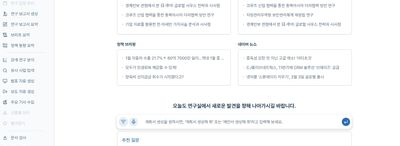
The Research Support Service is an integrated platform leveraging hyper-scale AI to support the entire research process, from topic identification to report writing and dissemination of outcomes. It primarily targets public researchers, including those from the National Research Council for Economics, Humanities and Social Sciences and its 26 affiliated research institutes. It was developed to efficiently analyse vast volumes of policy research data and enhance research quality and productivity.
The Medical Artificial Intelligence R&D Roadmap (2024–2028), published in September 2024, is a national initiative to strengthen the development and adoption of AI in healthcare. It aims to improve medical services, support AI-based medical devices and drug development, and enhance data utilisation by developing interoperable health data systems, while reinforcing regulatory frameworks, ethics, and workforce capabilities to ensure safe and effective implementation.
The Committee will deliberate and coordinate on the following: key AI-related policies, AI-related R&D strategies, AI-related investment strategies, and public-private cooperation and AI industry development strategies aimed at boosting the national AI competitiveness.