Name in original language
Tetti Rossi - Tetti Verdi - Gemello digitale esteso - PN Metro Plus 21-27
Initiative overview
Red Roofs
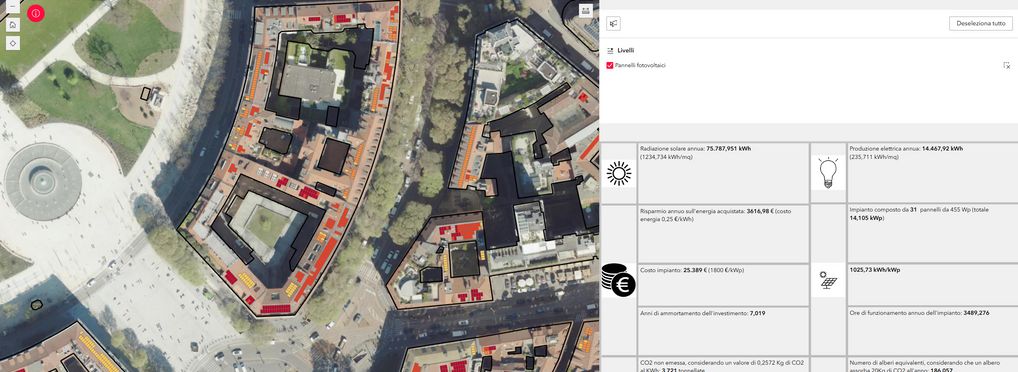
In order to accelerate the achievement of carbon neutrality by advancing the 2050 deadline, and in compliance with the Sustainable Energy and Climate Action Plan (PAESC), the Municipality of Milan started developing a GIS-oriented web application, supported by AI algorithms for the automatic analysis and classification of geospatial data. This application is capable of identifying the morphology of buildings’ roofs and grouping them by type (flat roofs and pitched roofs), identifying the optimal roof pitches, i.e. those exposed to a suitable orientation, for simulating the installation of photovoltaic panels. The calculation has been based on the available classified "point cloud" generated by the LiDAR flight, with an average density of over 20 points per square metre. The goal is to address municipally owned buildings first, in order to encourage interventions on private buildings to increase self-consumption of electricity produced by photovoltaic panels with the presence of storage systems. The next step will be to incorporate this initiative into the broader Air and Climate Plan (PAC), inspired by the municipality, promoting public-private partnerships (PPP) with a project financing mechanism that will leverage the financial contribution already made available. This initiative will also allow for similar interventions on privately owned buildings, promoting them with tax breaks.
Green Roofs
Green roofs and green walls can generate a multitude of benefits, such as reducing the "heat island" effect; increasing the energy efficiency of buildings; improving stormwater management by reducing sewerage; improving air quality; increasing biodiversity in urban areas; improving the microclimate by reducing temperatures; and, where possible, by creating social spaces that improve human psychological well-being. Using a similar methodology and with the support of AI algorithms, a GIS-oriented web application for the identification of flat roofs was created. This application is suitable for the installation of plant-based structures that require reduced nutritional and energy input, low thickness and weight, and low management and installation costs. The application also uses the identification and delineation of urban heat islands, within which the Building Regulations guarantee a bonus for reducing the RIC (Climate Impact Reduction). Looking ahead, this initiative will allow the Municipality to address a technical issue: verifying the building's static stability, in order to ensure the effect of additional loads that were not foreseen in the building's design. It could address a legal issue as well: defining an administrative approach capable of managing the public use of undivided private property.