





















Initiative overview
Occupational licensing serves legitimate purposes, but requirements that exceed what public interest justifies prevent people from entering occupations and reduce labor market competition. Czechia regulates more than 300 professions, and for several professions regulatory restrictiveness has been found to exceed the EU average, yet no systematic assessment has been made of whether the requirements are still justified across the board.
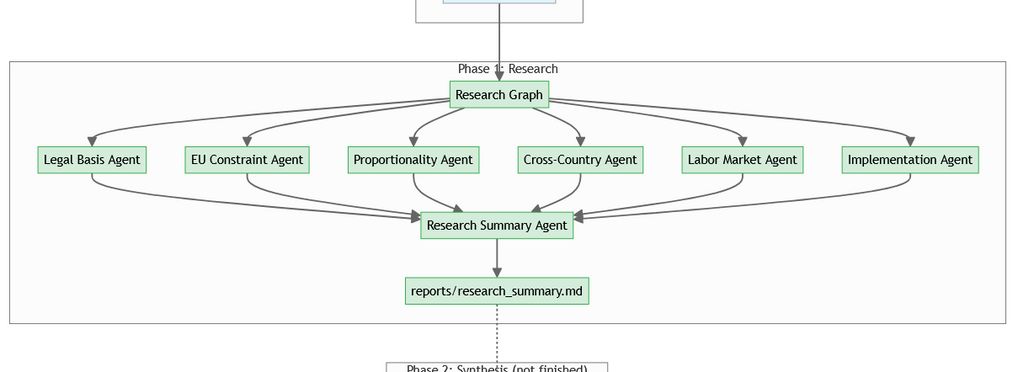
The Government Analytical Office developed an automated multi-agent system to conduct this assessment at scale. For each profession, specialized AI agents independently search online legal sources, official government databases, and EU-level registers to research six dimensions: the legal basis under Czech law, EU-level constraints, whether requirements are proportionate to documented risks, how Czech requirements compare to those in other member states, labor market effects, and how regulation is enforced in practice. The system synthesizes these findings into a structured assessment with a ranked simplification recommendation. This analysis would take months to complete manually; the automated system might reduce it to weeks, making comprehensive reform easier.
Where the system identifies a simplification candidate, findings will be shared with the Ministry of Industry and Trade and relevant social partners to assess whether sufficient justification exists. Where it does not, a formal proposal will be submitted to the government. Poland's experience with simplifying access to professions between 2005 and 2015 is instructive: empirical literature suggests such reforms are associated with increased labor market entry and employment growth in affected occupations, though effects vary by profession. Workers currently blocked from entering regulated professions, as well as businesses and the broader economy, stand to benefit from a successful reform.
The methodology relies on publicly available legal sources and EU-wide databases accessible to any member state, making it directly replicable by other governments. The system is currently being scaled to cover all regulated professions in Czechia, and the same approach can be extended to other regulatory domains, such as identifying gold-plating across Czech legislation more broadly.
The system has been piloted on 15 professions, with 5 outputs validated in detail. In several cases, analysis found no EU requirement to regulate the profession and no equivalent licensing requirement in comparable member states such as Poland and the Netherlands, indicating concrete simplification potential. Output quality is assessed through a structured evaluation pipeline in which an LLM judge scores agent responses against predefined criteria — a methodology designed to scale validation across all professions. The full analysis is underway, and validated findings will be submitted to relevant ministries to inform concrete proposals to the government.