Name in original language
Gov.pt Assistente Virtual
Initiative overview
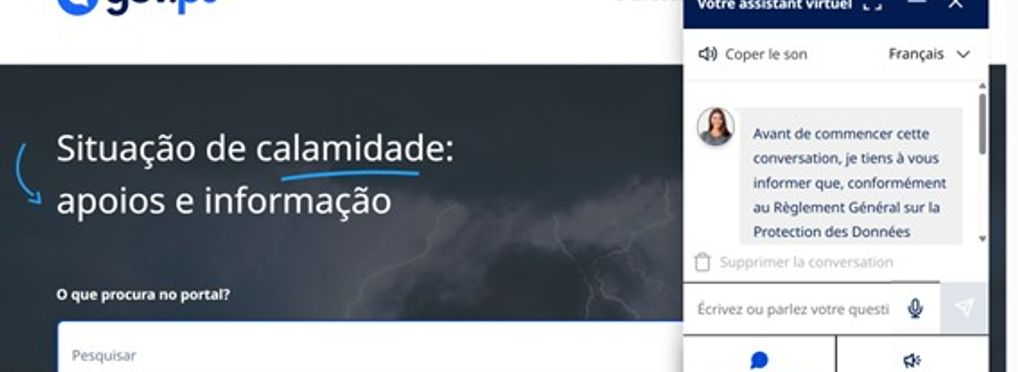
The Gov.pt virtual assistant is a generative-AI chatbot embedded in the Portuguese single public services portal. Using a curated public-services knowledge base and retrieval-augmented generation (RAG), it answers questions by text or voice and can also be used through a chat interface with an animated avatar. It supports 12 languages, according to the nationalities that most frequently use Portuguese public services (Portuguese; Brazilian Portuguese; English; Spanish; French; German; Italian; Bengali; Hindi; Nepali; Mandarin; Ukrainian; Russian) and covers information for more than 2,300 services, helping users to quickly identify requirements, administrative steps, service delivery channels and where to go next.
It tackles a core opportunity in digital government: reducing information asymmetry and navigation complexity that drive in-person visits, repeated calls and abandoned processes. The main objectives are to
- (1) provide consistent, accessible, multilingual guidance 24/7;
- (2) shorten the time to find the right service and reduce errors when preparing the documents and information needed in advance to access a specific service;
- (3) improve inclusion for non-Portuguese speakers, people with lower digital literacy and users with accessibility needs; and
- (4) generate evidence (analytics + feedback) to continuously improve the Gov.pt portal content.
Implementation combined iterative delivery with strong quality controls: a 2023 pilot on a limited scope, a Minimum Viable Product to test languages and accuracy with content and language experts, front-end integration and document ingestion, guardrails for tone and follow-up questions, performance metrics, stress testing and deployment in late 2024. The virtual assistant operates within Gov.pt’s governance framework, with ARTE and partner agencies working together to keep source information and content accurate and updated.
From 2026 onward, the roadmap expands from informational support to assisted completion of services: broader scope, transactional capabilities, process tracking and appointment scheduling with public bodies. The modular design allows scaling to more services and deeper integrations while maintaining human oversight, privacy safeguards and continuous monitoring to sustain trust and institutionalise the solution across agencies.