






















Can we create a clear understanding of what agentic AI is and does?





Sara Rendtorff-Smith, Francesca Rossi, Kasumi Sugimoto, Luis Aranda, Vincent Corruble
March 3, 2026 —  4 min read



AI agents and agentic AI based on large language models are becoming more autonomous and capable of interacting with both physical and virtual environments. As the capabilities of these AI systems grow, they are gaining visibility, and with reason. It is reaching a point where they could become the driving force behind innovation, investment and improved productivity across sectors by streamlining processes and enabling more efficient operations.
While ideas related to agency have long been explored in academic research in fields such as philosophy, economics and computer science, recent advances in AI are stretching conceptual boundaries. As AI’s capabilities evolve, so do our shared understanding of what qualifies as AI agent and agentic AI.
The OECD report, The agentic AI landscape and its conceptual foundations, developed by the OECD.AI Expert Group on Agentic AI, helps clarify what AI agents and agentic AI are and how they differ. Grounded in the OECD AI system definition, the analysis examines how these terms are defined and used across the literature. By analysing key features, overlaps and distinctions and mapping them to the core elements of the OECD definition of an AI system, the report helps to establish more precise and consistent terminology. And in a rapidly evolving field, conceptual precision is essential for effective, well-informed governance.
Three key messages stand out in the report:
- AI agents and agentic AI are closely related, but not interchangeable.
- Agentic AI ought to be seen as a socio-technical paradigm.
- Despite technological gaps and varying levels of maturity in areas such as digital security and privacy, uptake is growing.
The common foundations and meaningful distinctions of AI agents and agentic AI
Our analysis shows that AI agents and agentic AI share foundational characteristics. Both involve systems with a degree of autonomy that pursue goals and can perceive and act within physical and virtual environments.
However, there are differences that mean these terms are not interchangeable.
- AI agents can be understood as systems that perceive and act on their environment with a degree of autonomy, using tools as needed to achieve specific goals and adapt to changing inputs and contexts.
- By contrast, agentic AI generally refers to systems composed of multiple co-ordinated AI agents that can break down tasks, collaborate and pursue complex objectives autonomously over extended periods. Agentic AI systems are designed to operate in more open-ended, less predictable physical and virtual environments, and to function with minimal human supervision.
In short, agentic AI is more complex, as it can co-ordinate multiple agents, perform task decomposition and delegation, and sustain operations over longer periods. It can also operate in more complex, less predictable environments with limited human oversight.
Agentic AI as a socio-technical paradigm
Agentic AI systems are not isolated technical artefacts. They are frequently embedded in social contexts and interactions and operate within a socio-technical paradigm.
Their value lies not only in autonomous action, but in interaction with other AI agents, humans and institutional processes. Co-ordination and negotiation across these actors require advanced reasoning capabilities, robust infrastructure and reliable communication protocols.
This relational perspective is an essential part of what agentic AI is. This means that understanding how they interact within broader ecosystems is essential to designing agentic AI systems that function responsibly and effectively, particularly in open or high-stakes environments.
Uptake is accelerating, but maturity is uneven
The report also presents descriptive evidence on trends in AI agent adoption. Many developers have already integrated them into their toolkits, and survey data indicate that nearly half of respondents on Stack Overflow use them or plan to do so.
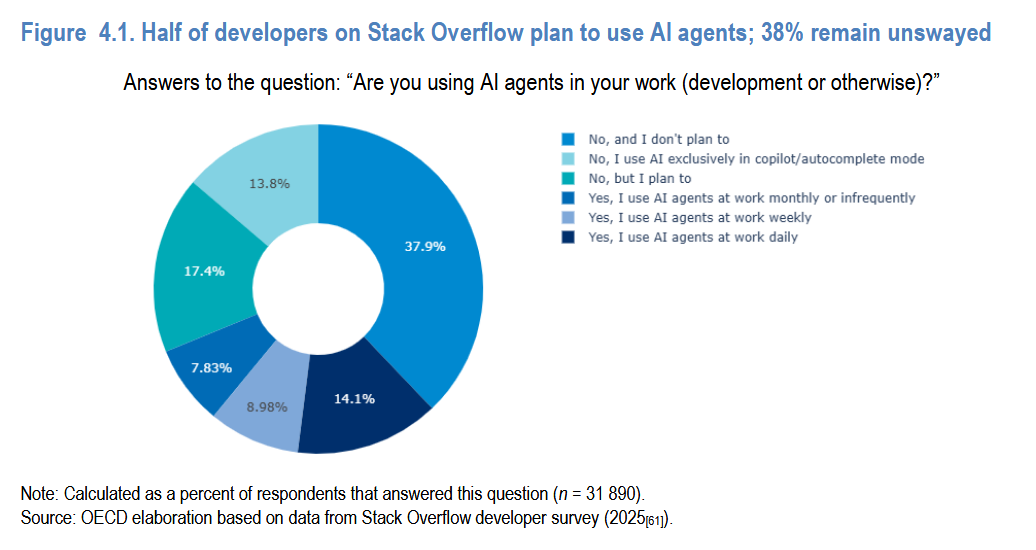
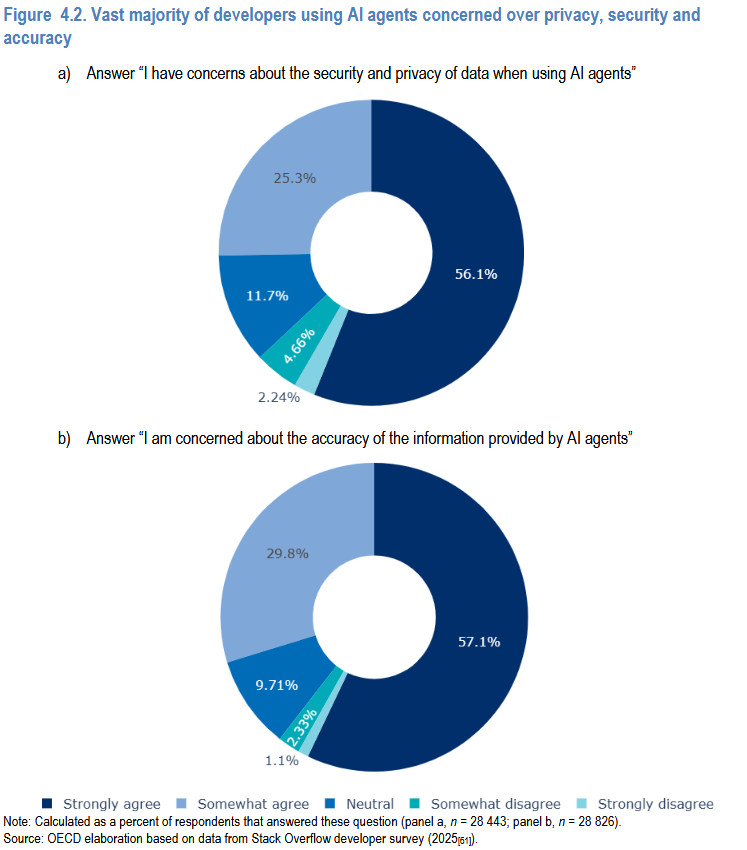
To be clear, adoption should not be confused with maturity. Developers highlight opportunities to further strengthen the security, privacy and accuracy of AI agents. These concerns underscore an important point: as the capabilities of agentic AI advance rapidly, progress in robust, trustworthy AI systems must keep pace.
A foundation for further analysis
Overall, the report provides a descriptive overview of the agentic AI landscape, clarifying key concepts and characteristics and establishing a shared analytical foundation. By anchoring the discussion in the OECD AI system definition, it aims to promote coherence across technical and policy communities.
Looking ahead, an improved understanding of real-world use will be essential to identify where safeguards, standards, and governance mechanisms will be most effective. Policy-relevant typologies that build upon this work could help guide governance efforts to distinguish systems by level of autonomy, degree of adaptiveness, domain of operation and scale of impact. Evidence-based policymaking will require more empirical data on how AI agents and agentic AI are being adopted and used across sectors, as well as clearer evidence of their broader implications and impacts.
This report contributes to a clearer, shared understanding of agentic AI and provides a basis for thoughtful, forward-looking policy grounded in conceptual clarity. As agentic AI systems become more capable of coordinating multiple AI agents, taking action and operating over longer periods, governance conversations have to keep pace.